

France’s Debt Problem Won’t Stay in France

In this article:
Last weekend, the world awoke to images of Limoges’ 19th-century town hall aflame.
Shocking footage of violent protests, rioting and looting across various cities in France played out across TV screens around the world.
At the same time, protesters took to the streets in Italy, Albania, Spain, Belgium, and Portugal.
While grievances differed slightly, they could collectively be blamed on a ‘cost-of-living crisis’.
Protesters cited crumbling education and healthcare systems, rising living costs, unaffordable housing, and low wages.
But what is the common thread linking all of these events?
Debt.
The answer shows why this will not be limited to France, or even just to Europe.

France is descending into a debt spiral
France is perhaps the clearest symbol of this debt crisis.
France is one of the world's largest economies and a cornerstone of EU stability.
It also operates a massive welfare state, spending almost a third of its entire economy (32% of GDP) on social benefits.
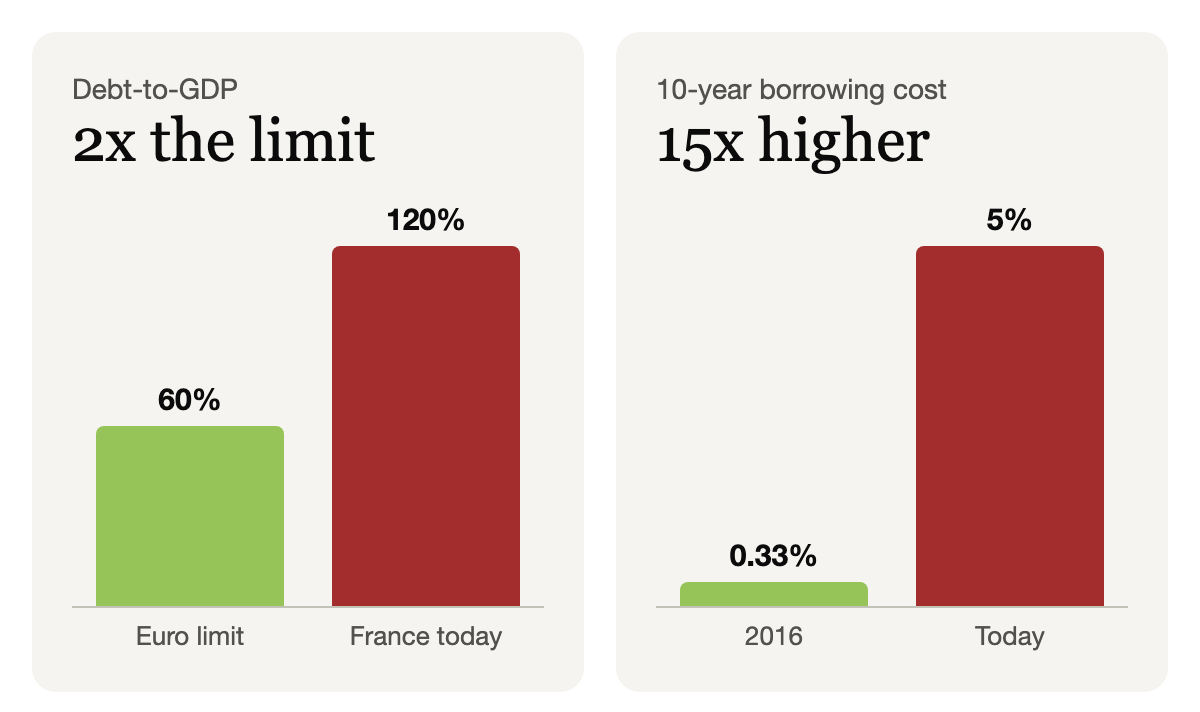
France’s debt-to-GDP ratio is currently almost 120%. That number alone still doesn’t hint at the scale of the problem.
120% is twice the 60% debt limit originally agreed upon for countries that joined the Euro.
To get back down to 60%, France would need to shut down the entire state - that’s right, not spend a single penny - while still collecting every euro of revenue, for 14 straight months.
Of course, this is impossible because GDP would collapse long before the debt threshold was ever reached. Still, it illustrates just how enormous the gap is.
And it is still growing, with France’s deficit at 5.4% of GDP this year.
To make matters worse, France’s long-term borrowing costs are increasing rapidly.
Back in 2016, the 10-year bond yield was 0.33%. Today, it is 5%.
So what does a government that is in a hole this big do in the short term?
They cut budgets (or at least try to) and raise tax revenue.
That means crumbling public services at a higher cost, which is exactly what brought the French protestors out on the streets back in September.
But France is at an impasse. Parliament can’t pass the budget cuts, and even if it did, they would reduce the deficit, not the overall debt.
Borrowing costs rise as the bond market sees France as an increasing lending risk.
Higher borrowing costs mean more of the state’s money goes to interest payments, and less goes to essential services for citizens.
And then the people march in the streets. Some riot, damage, and loot.
As macro analyst Lyn Alden pointed out, fiscal issues lead to social issues, which lead to more fiscal issues and more social issues.
France is just a symptom of a larger problem
Right now, you may be thinking: well, I’m not French, and I don’t live in France, so how does this affect me?
France may be the most visible example right now of what happens when a country goes broke, but it is by no means unique.
It’s just ahead of most other developed economies.
Canada, the US, the UK, Belgium, and Italy all have debt-to-GDP ratios exceeding 100%.
Like France, they all have rising bond yields, the number that will dictate how much of their GDP goes toward debt servicing in the future.
In the short to medium term, governments can cut public spending and raise taxes.
But in countries where taxes are already punitive, and pensions are a sacred cow, these measures are political kryptonite that few politicians will touch.
This is the stage where you see public schools under strain, healthcare systems failing, and an increasingly vocal minority demanding that the government ‘tax the rich’.
Sounding familiar yet?
The government is backed into a corner.
The election cycle means they are unwilling to take unpopular austerity measures, and only so many wealthy people will stick around long enough to be taxed more.
This is where financial repression comes in.
What is financial repression?
It's a way for governments to reduce sovereign debt without needing people to vote for it. It isn't an official policy.
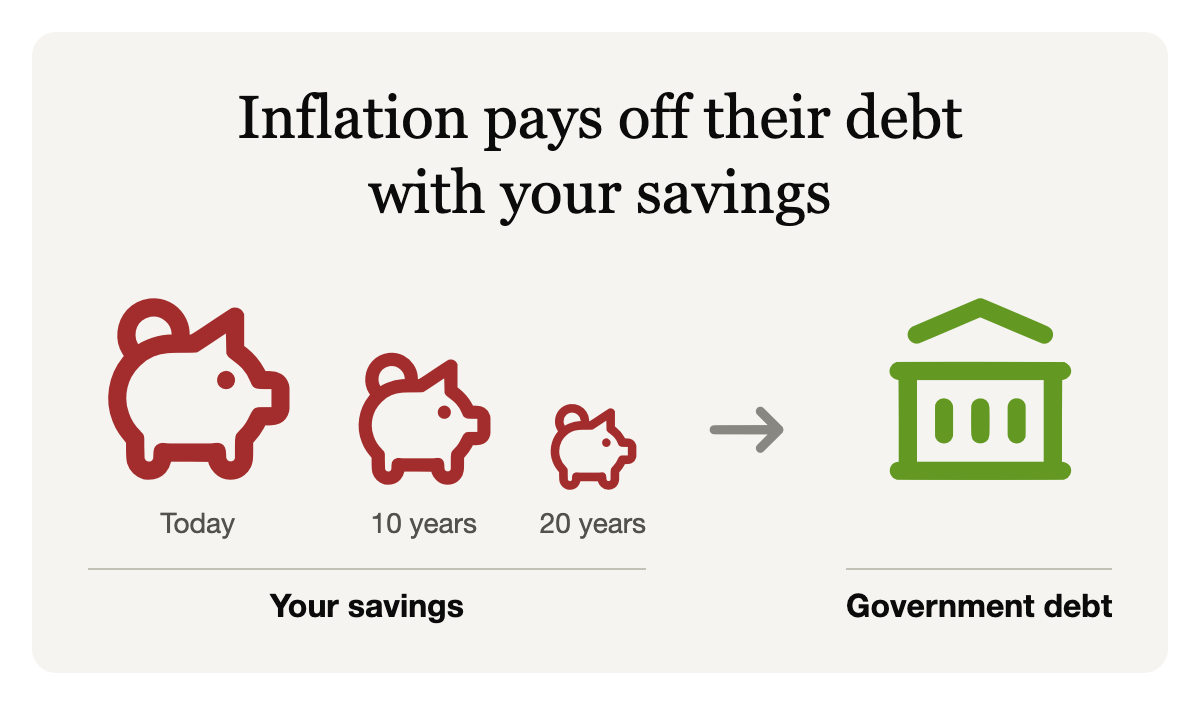
It is austerity and impoverishment by stealth, the quiet robbing of your wealth to pay for your government's sins.
Financial repression usually involves:
- Keeping the interest paid on government debt below inflation and
- Ensuring that savers cannot easily avoid it.
Of course, EU countries like France have less control over setting rates and enacting QE because they aren’t monetarily sovereign and can’t print their own currency.
They have to rely on ECB (European Central Bank) interventions, and any rescue comes with conditions.
The main difference between France and a monetarily sovereign country like the US or Australia (one that issues its own currency) is that all EU citizens inevitably bear the cost of addressing France’s debt problem through financial repression.
5 signs you're already paying for their debt
Where do we see the tools of financial repression showing up in our lives, and what can we do to protect ourselves?
You probably already recognise some of the following occurring in your own country:
1. Your savings lose value
- Your bank account doesn’t pay enough interest on cash savings to keep up with real inflation, forcing savers to seek other places to store wealth.
- Monetarily sovereign nations will run QE programmes, and new money will enter the system at the top, inflating assets like stocks and property.
- Taxes on nominal capital gains created by inflation will still be taxed at punitive rates.
2. You pay more and get less
- Taxes will rise, or new taxes will be introduced, especially those targeting asset owners and the wealthy.
- Austerity measures will be introduced - pensions frozen or cut, less spending on public infrastructure and services.
3. Your money is steered into government debt
- Pension funds and insurers are pushed, by rules and pressure, to hold more government debt.
- New digital tools like stablecoins will have requirements to be backed by a certain amount of government debt.
4. Your money gets harder to reach
- Withdrawals on savings products can be frozen.
- Access to cash can be limited or phased out over time.
- CBDCs are being built, which allow governments tighter control over how you spend and save your money.
- Bank bail-ins are possible, where customer deposits can be used to rescue a failing bank.
5. Your exits narrow
- Governments may implement measures to prevent capital flight, such as exit taxes.
- Governments may impose capital controls if other punitive measures aren’t enough.
- Pressure on the escape valves, such as precious metals and Bitcoin, through confiscation or reporting rules.
What can you do to protect yourself?
So what can you do about it?
These systems are designed to be very difficult, if not impossible, for the average person to escape from.
However, if you’re reading this, you’re not just an average person. You probably already recognise the problem and are aware that there are already tools that you can use to protect yourself from indebted governments stealing all your wealth.
First, you must be financially sovereign. If you don’t already, hold Bitcoin in self-custody. If you get this right, you will never need to trust a third party to hold, access, or spend it.
Bitcoin in self-custody sits outside the system, so if the government starts freezing bank accounts, seizing assets, or preventing money from crossing physical borders, your Bitcoin isn’t held anywhere those measures reach.
Be very wary of buying Bitcoin-backed financial products like ETFs and treasury companies, because they are part of the legacy financial system and have many layers of custodians between you and Bitcoin.
Become jurisdictionally sovereign
And second, you need to have residency options to increase your jurisdictional sovereignty.
If your country is grappling with a massive debt-to-GDP ratio, a large annual deficit, and rising borrowing costs, financial repression tools are already on the table.
A Plan B residency doesn’t mean that you need to leave your home country immediately. In fact, you don’t need to leave at all, but you do need peace of mind that you have options if you ever need them.
At The Bitcoin Way, Panama is our #1 choice for second residency.
Panama has become the Plan B (or, in some cases, the Plan A) for nearly half of The Bitcoin Way team. If we didn’t believe it was the best option, we wouldn’t be moving there!
Back to France.
France is not unique by any stretch.
Since last weekend’s unrest, the government has imposed curfews in several affected areas.
More demonstrations were planned for this weekend, and the government moved soldiers from its anti-terror patrols onto guard duty so police could focus on the marches.
This is not a France-only story. It warns what debt, rising costs, and financial repression can look like when they spill into the streets.
France is offering a preview of what could happen in countries where debt begins to spiral and servicing it becomes unmanageable.
We will all see what happens in the streets, but pay close attention to how France manages the problem financially, because it will be instructive for other indebted Western economies.