Glossary
Bitcoin, Cybersecurity and Citizenship programs are full of acronyms and unfamiliar language. Use our glossary to look up useful terms you’ll come across on your journey.

A password plus a second step (like a phone code) to keep your account safe.
A unique string of characters where you receive Bitcoin — like a bank account number. Your wallet has many addresses; the monitoring system watches all of them.
A hardware device that is not physically connected to any computer or Internet device, instead using tools such as QR codes or SD cards to pass information between devices.
The open-source software installed on your phone that receives notifications from your Start9 server when transactions occur. Displays no Bitcoin information until an alert fires.
The main Bitcoin blockchain where all official transactions are stored.
A suggestion for upgrading Bitcoin. For example, BIP39 created the 12 or 24-word seed phrases we use for wallets.
A decentralized, peer-to-peer, globally available digital money used to send and receive value without need for permission, fear of censorship, or third-party intermediaries.
The main software that runs the Bitcoin network and allows users to verify transactions by running a full node.
A "box" of Bitcoin transactions. Every 10 minutes, a new block is added to the chain.
A technology that serves a crucial role in Bitcoin and acts as a "distributed public ledger" that links all "blocks" of transactions in a contiguous, immutable "chain."
A legal status that signifies full membership in a nation or state, granting individuals rights such as voting, access to a passport, holding public office, and accessing social services, along with responsibilities like obeying laws and paying taxes.
Malware that changes a Bitcoin address in your clipboard to the hacker’s address. Always double-check the address before sending!
A method of custody whereby Bitcoin is stored entirely offline and inaccessible to anyone without direct, physical access to a wallet.
A transaction that has been permanently recorded in a block on the blockchain. Once confirmed, it cannot be reversed or stopped.
A Bitcoin wallet where a third party holds the private keys on your behalf.
Involves protecting personal or sensitive data from exposure to unwanted third-parties, including names, addresses, Internet traffic, government IDs, and others.
AI-generated fake videos or audio that impersonate people you trust to manipulate you into sending funds or revealing secrets.
Allows remote workers to live and work in a country legally while performing their job online for a foreign employer or business.
A service provider that translates and routes Internet traffic by converting URLs (e.g., www.thebitcoinway.com) to computer-readable IP addresses for the purpose of serving and delivering websites to end users.
A person's permanent legal home, often used in tax and legal contexts.
Holding citizenship in two countries simultaneously.
A fake wallet or second password you give up if you're being physically threatened.
Tiny bits of Bitcoin that cost more to send than they’re worth.
A process whereby individuals can obtain citizenship in a country through financial investment, often taking the form of registering a business, purchasing real estate, or providing a gift to the government.
Your personalized step-by-step playbook for exactly what to do if an alert fires — who to contact, which tools to gather, and in what order. We create this together during setup.
The process of converting data into an unreadable format to those without proper keys for protection of sensitive information.
A security system that monitors and controls, then blocks or permits, incoming and outgoing network traffic based on predetermined rules.
A hack where the code running on a hardware wallet is tampered with to leak your private keys.
A strategy for diversifying citizenship, residency, and assets across multiple countries to optimize freedom and security.
A computer running Bitcoin Core that fully validates all transactions and blocks. It helps enforce the rules of Bitcoin.
The process of tracking, freezing, and potentially recovering stolen Bitcoin through investigators and exchanges. Success depends heavily on speed of detection.
The very first Bitcoin block, created by Satoshi Nakamoto in 2009.
A residency program offering residency or citizenship in exchange for significant investment in the host country.
Every 4 years, Bitcoin mining rewards are cut in half. This makes Bitcoin rarer over time.
A small, handheld device used for storing private keys and signing Bitcoin transactions.
Originally a typo of “hold.” Now it means: don’t sell your Bitcoin — hold through the ups and downs.
A Bitcoin wallet connected to the Internet, typically used for daily transactions.
Anyone with privileged knowledge of your holdings or security — family, employees, service providers, friends — who might exploit or leak that information.
A unique web address that enables transmission of data, websites, and other information across the Internet.
A hidden program that records what you type, which could steal your passwords.
A process used by exchanges and financial services to verify customer identity; not required to work with The Bitcoin Way.
A system built on top of Bitcoin for instant, cheap payments.
The waiting room for Bitcoin transactions before they get added to a block.
When your Bitcoin use leaks info like IP address, browser data, or transaction patterns.
The use of two or more authentication mechanisms (e.g., a password plus an authentication code) to log in or access services.
A method to enhance Bitcoin custody security by requiring multiple private keys to authorize a Bitcoin transaction.
The legal process by which a non-citizen acquires citizenship in a foreign country.
A computer running Bitcoin software that validates your own transactions. Your Start9 is a node — it checks the blockchain directly instead of trusting a third party to tell you what's happening.
A special visa designed for remote workers or digital nomads allowing them to live in a foreign country while working online.
A wallet where you hold the private keys and have full control over your Bitcoin.
Bitcoin bought without giving up personal information, often considered more private and censorship-resistant.
Software where the code is public and audited by the community. Anyone can inspect it for security flaws. We use open-source tools, not proprietary black boxes.
The software that supports a computer or phone’s general functions, including running applications and authenticating users.
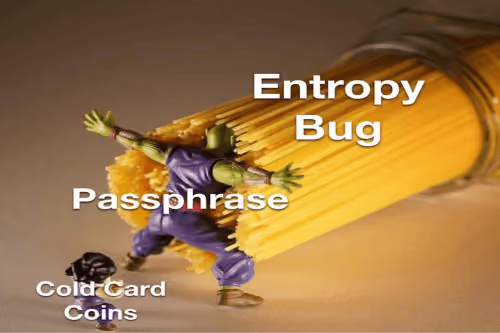
A “25th word” created by the user that is appended to a seed phrase to generate a new Bitcoin wallet and increase overall security.
A seedphrase can be anything you like, but to be secure make sure to use something of a reasonable length and include numbers, letters and special characters. Here's an example:
H1deY0urE@sterEgg$
Direct communication or transaction between users without intermediaries, which Bitcoin enables.
A legal status that allows an individual to live, work, and study indefinitely in a country without becoming a citizen, while typically granting access to many of the same rights and benefits as citizens, except for voting and holding certain public offices.
Fake emails, messages, or websites designed to trick you into revealing private information or downloading malware.
The "$5 wrench attack" — physical threats, kidnapping, or home invasion to force you to transfer Bitcoin under duress.
A unique number, usually six digits in length, used to access a Bitcoin hardware wallet.
Legal access to live in, either temporarily (temporary residency) or indefinitely (permanent residency), a foreign jurisdiction, used as a backup option in the event of war, economic turmoil, or other catastrophic event affecting one's native country.
A phone designed with features that enhance user privacy.
A cryptographic key that allows a user to access and control their Bitcoin.
Blockchain forensics firms that track stolen cryptocurrency, work with exchanges to freeze funds, and coordinate with law enforcement. Specialized expertise your local police likely doesn't have.
Software that is privately owned, with its source code hidden from users, limiting modification and redistribution.
Like your account number. It’s used to make your Bitcoin address.
A specialized type of barcode designed to store information for wireless transmission of information, such as for signing Bitcoin transactions.
A fake QR code that looks real but sends Bitcoin to a hacker’s address instead of yours.
Properly storing multiple copies of your seed phrase (e.g., metal plates) to avoid loss due to fire or water damage.
The ability to access a device, such as a Bitcoin node, when not connected to the same wireless network.
A Bitcoin feature that lets you broadcast a new version of an unconfirmed transaction with a higher fee, effectively redirecting funds to a different address. If you catch theft during the unconfirmed window, you might redirect funds to safety.
Long-term social engineering where an attacker builds a fake romantic relationship to eventually extract funds or security information.
While common in altcoins, in Bitcoin this can refer to scam services or wallets that disappear with users' funds.
A small device used for saving information; may be used for signing Bitcoin transactions with a hardware wallet and inserted into a computer to finalize sending via a software wallet.
A series of words generated by your wallet to recover your Bitcoin if lost. a 12 word seed phrase would look something like this:
- wood
- layer
- decorate
- antique
- spirit
- suffer
- hub
- spoil
- goddess
- health
- above
- enrich
A 2017 upgrade that made Bitcoin transactions smaller and cheaper.
Controlling your Bitcoin without relying on third-party custodians.
Software that runs on your own hardware (your Start9 server) rather than a third party company's servers. You own the data; nobody will see your addresses, balances, or alerts.
Software that runs on your own server instead of a company's cloud. Your monitoring app lives on your Start9; the notification app lives on your phone. Both are under your control.
The specific technical information about how you secured your Bitcoin. Insiders or social engineers target this information to estimate your holdings and attack vectors.
Psychological manipulation to trick you into revealing security information or sending Bitcoin. Includes pretexting, authority scams, and building false trust over time.
A Bitcoin wallet that runs on a computer, designed to initiate the sending and receiving of transactions and connected to a node for private transmission to the Bitcoin network.
A small private computer that lives in your home and runs your Bitcoin software. It's your personal server — like having your own cloud that doesn't touch the internet.
A country offering low or zero taxes to attract foreign individuals or businesses.
A legal status granted to individuals allowing them to live in a country for a limited period, typically for purposes such as work, study, tourism, or family reunification, without granting permanent settlement rights.
The unique identifier for a specific Bitcoin transaction — like a receipt number. Investigators use these to track stolen funds across the blockchain.
Attempting to stop or redirect a transaction before it confirms using RBF. Only possible during the brief unconfirmed window.
A transaction that has been broadcast but not yet permanently recorded in a block. This window — usually 10-60 minutes — is when RBF might allow reversal.
Unspent Transaction Output. Think of them as digital bills in your wallet. Each UTXO is a discrete chunk of Bitcoin you control. Investigators track UTXOs to follow the path of stolen funds.
A legal document granting permission to enter, stay, or work in a foreign country for a specified period.
A service that encrypts your internet connection and hides your IP address, enhancing your privacy online.
A unique ID generated to provide assurance that a user is viewing and using the Bitcoin wallet they intend to be accessing.
A wallet app that displays your balance and transactions but cannot spend funds. Convenient for checking balances, but risky because it exposes your addresses and reveals you hold Bitcoin to anyone with access to your phone.
Your total Bitcoin holdings. Slang for your pile of sats.
Pursue your
freedom today
Every journey begins by taking the first step. Book a free 30-minute consultation with one of our experts and let’s start securing your future.
Secure Clients Are Happy Clients
We build lasting relationships with our clients. Check out their feedback:
Don't trust; Verify:
Testimonials →.avif)
.avif)
.avif)

.avif)


.avif)
.avif)

.avif)

.avif)





.avif)
.avif)
.avif)




.avif)
.avif)
.avif)
.avif)
.avif)
.avif)

.avif)
.avif)








.avif)

.avif)
.avif)
.avif)
.avif)
.avif)


.avif)

"Lorem ipsum dolor sit amet, consectetur adipiscing elit. Suspendisse varius enim in eros elementum tristique."

"Lorem ipsum dolor sit amet, consectetur adipiscing elit. Suspendisse varius enim in eros elementum tristique."
"Lorem ipsum dolor sit amet, consectetur adipiscing elit. Suspendisse varius enim in eros elementum tristique."
"Lorem ipsum dolor sit amet, consectetur adipiscing elit. Suspendisse varius enim in eros elementum tristique."
"Lorem ipsum dolor sit amet, consectetur adipiscing elit. Suspendisse varius enim in eros elementum tristique."
"Lorem ipsum dolor sit amet, consectetur adipiscing elit. Suspendisse varius enim in eros elementum tristique."
Blog
Expand your Bitcoin knowledge with our latest blog articles