
Plan B Residencies Are Up Only
In this article:
You wouldn’t leave your entire Bitcoin stack on one exchange. So why are you still keeping your entire life under one government?
Most Bitcoiners understand counterparty risk when it appears on a balance sheet. We don’t trust custodians, we spread backups across locations and we remove single points of failure wherever we find them. Yet many of the same people leave their home, banking access, tax position, business, family and legal right to remain concentrated under one government, then call themselves sovereign because their seed phrase is safe.
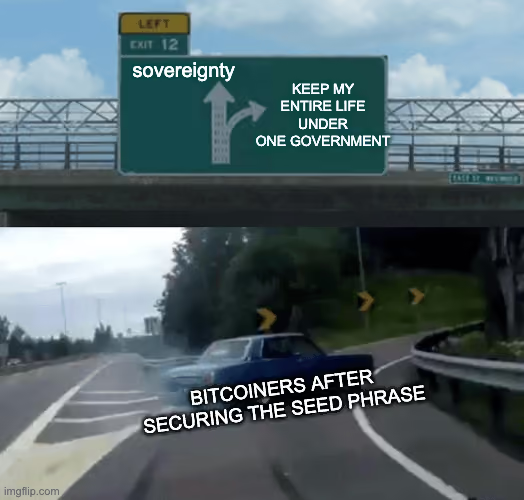
Self-custody protects your money. It doesn’t protect the world around it. Remember, a government doesn’t need to seize your Bitcoin to make the rest of your life miserable. It can turn your bank hostile, your tax bill punitive, your business into a compliance nightmare, or your ability to travel and speak conditional. It rewrites the rules without ever touching your keys. And suddenly the twelve-word escape hatch for your wealth feels incomplete. A fortune that can cross borders instantly doesn’t automatically grant its owner the legal right to follow it.
That right has to be secured in advance. A second residency is not a hobby for people who like collecting stamps. It is operational redundancy for your legal existence. It limits how much power any single government can exercise over where you are allowed to live, how long you can stay, and whether every practical part of your life must remain under its control. It gives you somewhere to go while leaving is still a choice, not an emergency.

Bitcoin keeps proving the “Up Only” case over time. Securing a second residency does the same for your freedom. Sometimes permanent residence becomes temporary first. Sometimes governments remove the easiest qualifying route, demand a deeper economic commitment or bury applicants beneath more documentation and source-of-funds checks. Sometimes the programme closes altogether, while those who acted early remain protected under the old rules.
The price doesn’t rise in one clean number because it’s paid in capital, time, compliance and lost opportunity. The door may still be open tomorrow, but it may be narrower, more expensive and guarded by conditions that don’t exist today.
In Europe Voted No. Brussels Counted It as Yes, we looked at how Europe is slowly converting freedom into permission, leaving formal rights intact while placing more of their practical use beneath institutional control. A Plan B is the answer to that drift. It prevents dependence on one jurisdiction from becoming permanent and removes the dangerous assumption that another country will still be waiting whenever you finally decide to leave.
Panama Changed the Price of Waiting
Panama doesn’t need to announce a future crackdown to prove that waiting can be expensive. It has already rewritten one of its most generous residency offers. When the Friendly Nations programme launched in 2012, nationals from selected countries could walk straight into permanent residence by showing professional or economic ties. The deal was simple: bring capital, skills, or business activity and Panama would roll out the welcome mat.
Then the bargain changed. The 2021 reforms replaced direct permanence with a two-year provisional permit. Applicants now need to qualify through employment in Panama, the purchase of at least $200,000 in Panamanian property, or a three-year fixed deposit of $200,000 with a local bank. Only after completing the provisional stage can they apply for permanent residence.
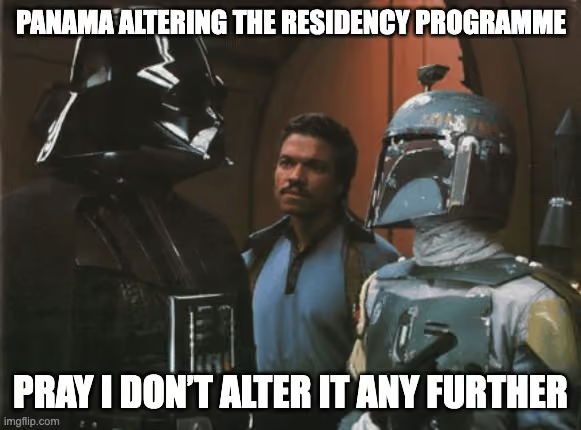
For anyone who intended to “get around to it eventually”, the cost of hesitation wasn’t a modest increase in government fees. It was two hundred thousand dollars of required capital, a deeper economic commitment and two additional years before permanence. People who waited didn’t simply pay more. They discovered that the original deal no longer existed.
That distinction matters because residency programmes aren’t products sitting patiently on a shelf. They are instruments of government policy. A country creates generous terms because it wants something: capital, labour, entrepreneurs, property demand or international talent. Once enough people respond, or the political priorities change, the state has every incentive to ask for more.
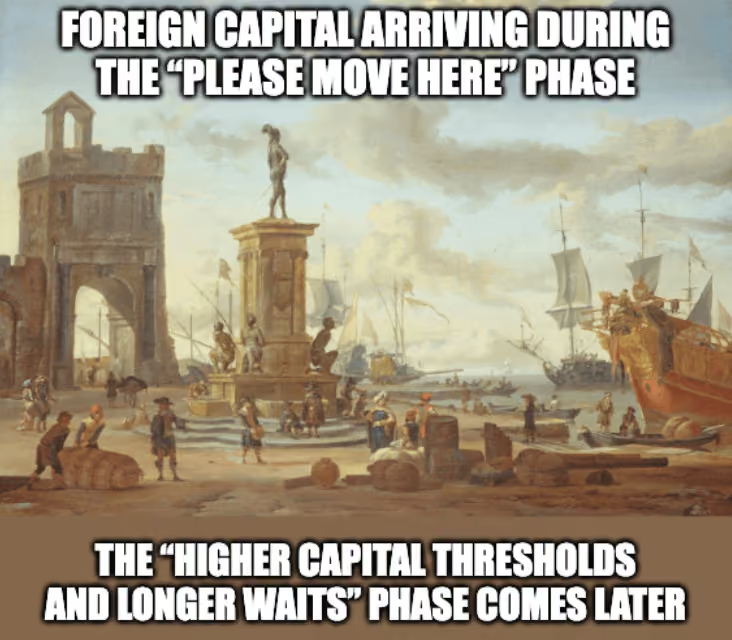
There is an old precedent for this. In the sixteenth century, the Medici rulers offered exceptional legal, commercial and religious privileges to attract foreign merchants to Livorno. The policy worked, helping transform the city into one of the Mediterranean’s great trading ports. The privileges weren’t acts of charity. They were incentives offered while mobile merchants were scarce and valuable. Modern residency programmes follow the same logic. Recruit first. Normalize later. What begins as an invitation can become a toll gate once the route is successful.
Panama remains one of the most compelling jurisdictions available to people seeking greater geographic and financial optionality. It combines a territorial tax system with the US dollar as legal tender, strong international connectivity and a mature commercial, legal and banking ecosystem. It also offers several residency routes for different circumstances rather than forcing every applicant into the same expensive golden visa. The danger is assuming Panama’s competition for residents puts applicants in control. It doesn’t. The government writes the offer, decides how long it remains available and owes future applicants nothing when the terms change.
Professionals we work with in Panama believe the residency environment is likely to become more restrictive as demand grows and international compliance pressure intensifies. No general reform has been formally announced, but waiting for an official countdown misses the point. By the time a government tells you the window is closing, the people who prepared early are already inside it.
Will the version of Panama that fits your life today still be available when you eventually decide to act?

The Door Rarely Gets Wider
Anyone tempted to treat Panama’s 2021 reform as a local quirk should look at what happened elsewhere. Ireland delivered the cleanest lesson. On 14 February 2023, the government announced that its Immigrant Investor Programme would close to new applicants… the very next day. People already approved or in the system kept their status. Everyone still “researching” or waiting for the perfect moment discovered the door had already shut.
Spain took a slower path to the same outcome. Its golden visa allowed applicants to obtain residency with qualifying investments, including €500,000 in property. From April 2025, that route was axed for new applicants. Those already inside kept transitional protection. Those still thinking about it lost the option entirely. Portugal kept the programme alive on paper, which sounded comforting until you read the fine print. Real estate and simple capital transfers were removed as qualifying routes. Anyone planning to buy property and call it a Plan B suddenly faced a programme that technically still existed but no longer offered the version they actually wanted.

Greece went for price instead of closure. The popular property route that once started at €250,000 now demands €400,000 or even €800,000 in large parts of the country. Waiting didn’t make Greece disappear. It just made the same outcome significantly more expensive. Different countries, same game. Raise the price, kill the easiest route, add new conditions, or close the door completely. Existing applicants usually get grandfathered in because rewriting rules retroactively creates legal and political headaches. Future applicants get whatever is left on the table the day they finally stop thinking and start filing.
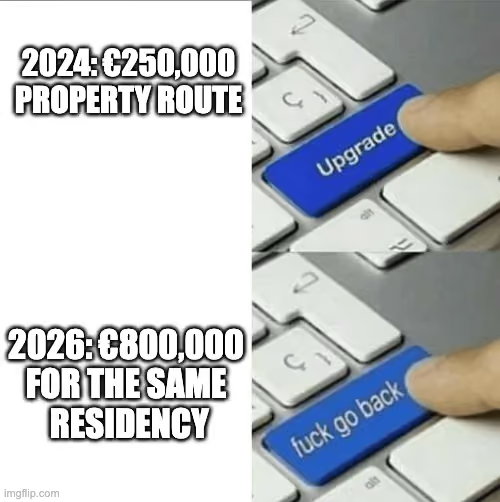
This is why waiting for certainty is so dangerous. Your preferred residency route is not an entitlement being held in reserve. It is an open offer from a government that can change the price, rewrite the conditions, or pull it entirely without waiting for your family to finish its decision process.
The Cost of Waiting
The worst time to discover that your freedom still depends on paperwork is when you urgently need to move.
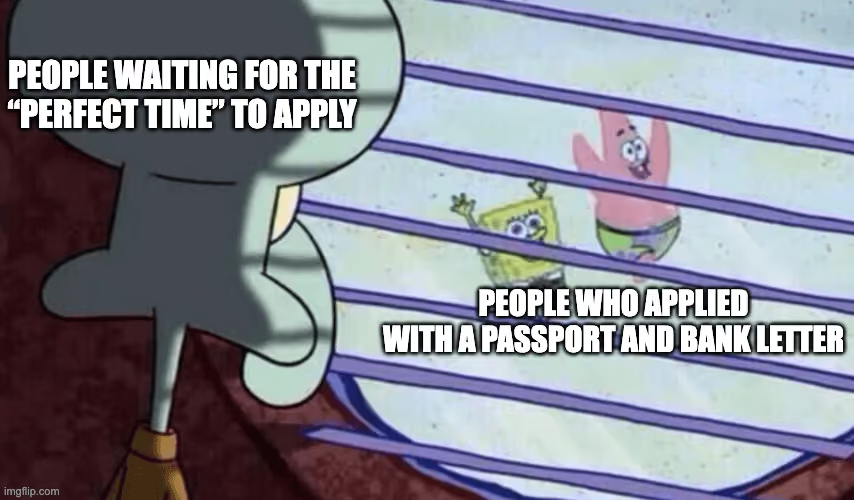
A residency application doesn’t start at the airport. It starts months earlier with police certificates, apostilles, bank references, proof of income, source-of-funds documents, property records, and everything else required for every family member. Some papers expire while you chase the others. Some must be issued in one country, legalised in another, and accepted by officials working on their own timetable.
When life is calm, this is tedious. When your bank has frozen an account, your tax position has changed or your family needs to relocate, every delay becomes expensive. Preparing early lets you compare routes, reject bad investments, correct mistakes and choose a jurisdiction because it suits your life. Waiting until circumstances force the decision means taking whatever route remains open, however costly, restrictive or inconvenient it has become.
This is the difference between mobility and escape. Mobility is planned. Escape is improvised under duress. Bitcoiners already understand this instinctively. You don’t create a backup after the device fails. You don’t design inheritance after the keys disappear with you. You prepare while everything works precisely because that is when preparation is cheapest and your decisions are still your own.
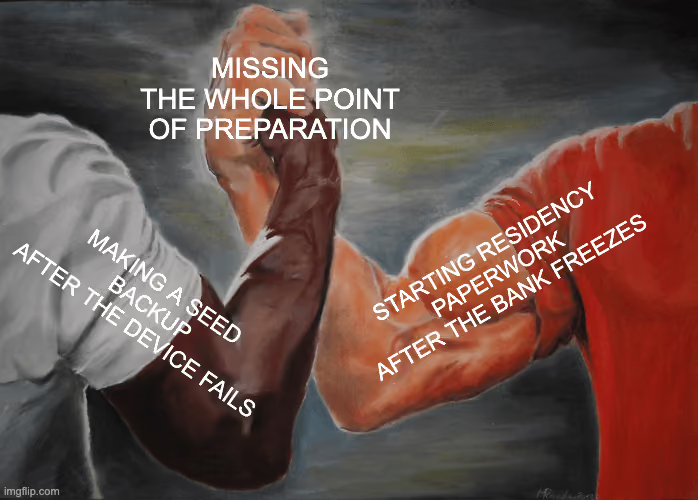
Jurisdictional resilience deserves the same seriousness. Sovereignty isn’t confidence that you’ll improvise successfully when the rules change. It is preparation that removes the need to beg for options under pressure.
A Plan B assembled during an emergency is usually more expensive, less flexible and less useful than one secured while it still feels unnecessary.
Better Five Years Early Than a Day Late
Panama still offers something increasingly rare: a real path to legal, geographic, and financial optionality before life forces your hand. A second residency doesn’t require you to abandon your current life, move tomorrow or spend every waking hour preparing for collapse. That misses the point. A Plan B is valuable precisely because it gives you another option without forcing you to exercise it.
Panama currently offers several routes suited to different circumstances and remains attractive because the country isn’t asking every applicant to fit the same narrow profile. But its history also shows that a generous route can be rewritten once the government’s priorities change. The earlier Friendly Nations bargain didn’t become slightly less convenient. It was replaced by a more demanding version that required substantially more capital or a deeper connection to the country.
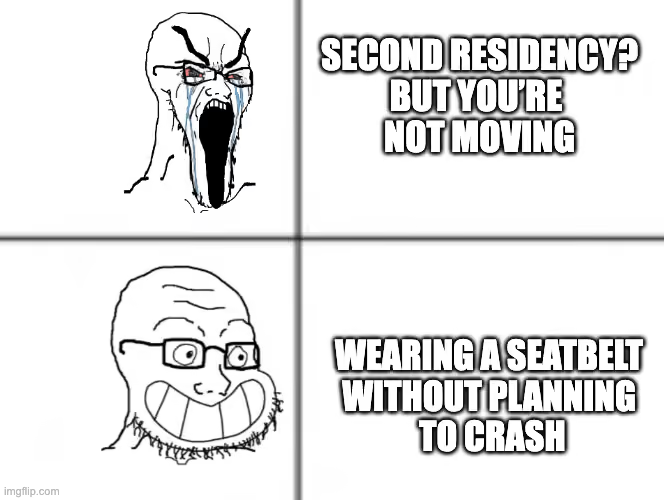
The point isn’t to predict the date of the next reform. Nobody can promise when the threshold will rise, when a route will narrow or whether the program best suited to you will remain untouched. The point is that waiting carries a risk that acting doesn’t: you may return later and find that the decision has already been made on your behalf.
Bitcoiners should understand this better than most. We know what happens when scarce assets meet rising demand, and we know that waiting for perfect certainty usually means paying a higher price for the same outcome. We also understand that rules imposed by others can change faster than our ability to react to them. You don’t need a precise forecast to recognize an asymmetric opportunity. You only need to see that acting early preserves choice, while delay leaves your future exposed to decisions made by someone else.
That is why early action isn’t panic but the refusal to let urgency dictate your choices. The person who begins while everything still works can decide whether Panama genuinely fits their life. They can secure the option, continue living where they are and move only if the circumstances justify it. The person who waits until their current jurisdiction becomes intolerable has fewer choices and far less leverage over the outcome.
The good news is that you don’t have to figure any of this out alone. We can help you understand which routes are genuinely available to you, identify the one that fits your circumstances and turn the vague idea of “getting a Plan B one day” into something concrete. Starting the conversation now gives you the chance to act while the terms still suit you, rather than returning later to find that the door has narrowed.
Book a free 30-minute introductory call with one of our advisors and find out what securing residency in Panama could look like for you. Acting early may feel unnecessary today, but that is precisely when you still have the widest range of choices. Better five years early than a day short.