
Single-Sig Isn’t Dead. Blind Trust Should Be.
In this article:
Why we still believe in single-signature Bitcoin custody, what hardware wallet security incidents can teach us, and why we’ve built Signature Lab.
Self-custody should give people greater control over their Bitcoin and greater confidence in how it is protected.
The objective isn’t to turn everyone into a cryptographer or convince people they need the most elaborate
wallet possible. It’s to build a setup they understand, can maintain, and know how to recover when the time
comes. Good security should leave people better equipped to understand their decisions and manage their
Bitcoin independently.
Yet conversations about Bitcoin security often begin at the other end. When a hardware wallet vulnerability
makes headlines, the immediate advice is frequently to add another signing device, move to multisig, or
introduce additional layers of protection. Sometimes those recommendations are entirely appropriate, but
complexity is not a substitute for understanding. A carefully constructed single-signature wallet can provide
excellent security, just as a poorly planned multisig arrangement can introduce unnecessary risks. What
matters is not how sophisticated a setup appears, but whether its safeguards address genuine threats and
remain practical for the person responsible for using it.
At The Bitcoin Way, that philosophy shapes the work we do with clients and the technical work we pursue
beyond those engagements. Today, our process includes having clients roll dice to contribute their own
randomness during seed generation, explaining the reasoning behind the devices and configurations we
recommend, and emphasizing recovery testing so people understand the safeguards protecting their Bitcoin.
We also keep that guidance moving forward. New research, firmware changes, and real-world incidents give us
opportunities to reevaluate assumptions, refine our methods, and bring what we learn back to our clients.
They benefit from that ongoing work without needing to become security researchers themselves, although we
encourage anyone interested to learn more and verify what they can.
Recent security disclosures illustrate why this approach matters. In July 2026, Coinkite, the company behind
Coldcard, disclosed a flaw affecting seed generation. Corrected firmware addresses the disclosed flaw for new
seed generation, but it cannot make an already weakened seed secure; affected users need to follow the
manufacturer’s migration guidance. In October, Ledger confirmed an unauthorized hardware implant in at
least one device sold through reseller CryptoBilis. Ledger’s subsequent investigation found that the physical
modifications were designed to capture recovery phrases during setup. These were different incidents
involving different weaknesses, and neither was an example of the malicious signing behavior discussed later in
this article. They are not reasons to abandon hardware wallets or assume that self-custody is inherently
dangerous. Rather, they remind us that security is an ongoing process of understanding, testing, and improving
the tools we rely on. [1] [2] [13] [14]
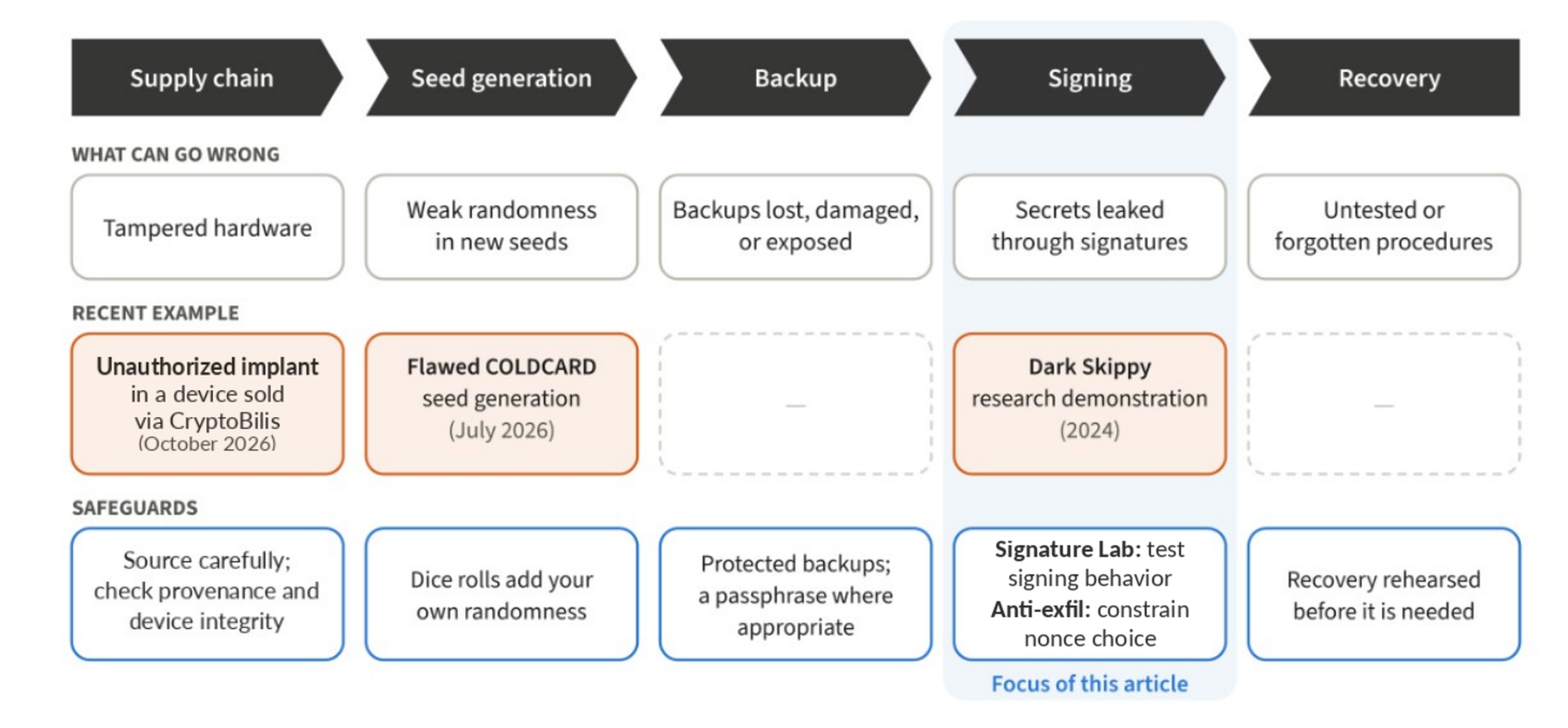
enough. Signature Lab addresses the signing stage.
One area that deserves more attention is what happens after a seed has been securely generated, when a
hardware wallet actually uses a private key to sign a Bitcoin transaction. Consider a device that generates a
secure seed, displays exactly the transaction its owner intends to authorize, and produces a mathematically
valid signature. Everything appears to have worked as intended, yet the signature itself could reveal
information that should have remained secret. Researchers have demonstrated that this is a genuine
cryptographic concern, and it raises an important question: how can we independently examine whether a
signing device is behaving as expected?
That question is one of the reasons we’ve built Signature Lab. Drawing on existing research and open-source
tools, we’ve developed a more accessible, repeatable way to investigate an important aspect of hardware
wallet signing behavior. For us, contributing to Bitcoin security means doing more than following the research
or recommending products. It means putting that knowledge to work, developing practical methods, and
sharing what we learn so the broader community can build on it.
Single-Sig Still Has an Important Place
Multisig offers substantial security advantages in the right circumstances. By distributing signing authority
across independent keys, it can limit the damage caused by the compromise of a single signer. In a properly
constructed 2-of-3 wallet, for example, a malicious device that exposes one independent signing key has not,
by itself, given an attacker the ability to spend the Bitcoin; in single-sig, compromise of the active signing key
can be sufficient. Multisig also provides useful arrangements for shared responsibilities, larger holdings, and
certain inheritance plans. We recommend it when those benefits justify the added responsibilities. Yet a
second or third key does not simply add protection; it changes what the owner must preserve, understand, and
eventually recover. More devices and backups must be accounted for, wallet configuration information
becomes more important, and a recovery process that appears straightforward today may be much less
obvious years from now.
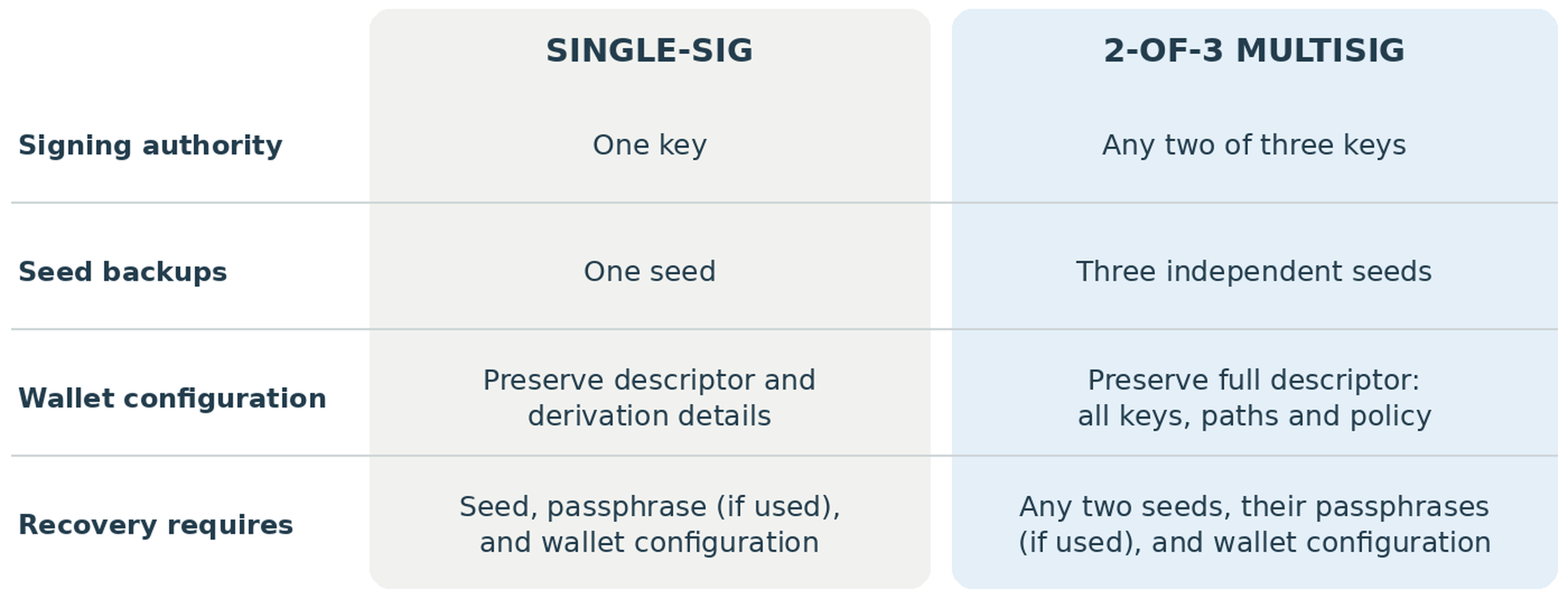
public-key information but is not a substitute for private-key backups.
This is why we resist treating complexity as a measure of security in its own right. A wallet can be exceptionally
resilient against a particular attack and still be poorly suited to the person responsible for maintaining it. When
we design a custody setup with a client, we consider not only what an attacker might do, but what ordinary life
is likely to demand. Devices break, procedures are forgotten, software changes, and sometimes the person
who must recover the Bitcoin is not the person who originally set up the wallet. A security arrangement that
cannot survive those circumstances has an important weakness, even if its cryptographic design is impressive.
For many people, a carefully constructed single-sig wallet strikes a better balance. Secure seed generation,
protected backups, a well-considered passphrase where appropriate, a suitable signing device, and a recovery
process that has actually been tested can work together to create a system that is both robust and
manageable. None of those measures removes the need to think critically about the device itself, but neither
does the possibility of a device-level vulnerability invalidate the entire approach. The goal is to understand
which risks have been reduced, which remain, and whether the owner can operate the wallet with confidence
when it matters.
A passphrase is a good example of why we need to understand the particular risk each safeguard addresses. A
strong BIP39 passphrase kept separately from the mnemonic can help protect a wallet if the mnemonic alone
is exposed. Once the wallet is unlocked for signing, however, a malicious device that has access to the derived
signing key can compromise that key regardless of how the wallet was derived. The passphrase has not failed
in that situation; the threat is simply different from the one the passphrase was intended to address.
That last question leads beyond the familiar debate between single-sig and multisig. However many keys a
wallet requires, each signer still performs a cryptographic operation when it authorizes a transaction. We
spend considerable effort examining how private keys are created and stored; the next question is whether we
understand enough about what happens when those keys are used.
A Secure Seed Is Only the Beginning
Bitcoiners pay close attention to seed generation, and rightly so. A weak random number generator,
compromised firmware, or predictable seed can undermine the security of an otherwise carefully designed
wallet. At The Bitcoin Way, our current seed-generation process includes having clients roll dice to contribute
their own randomness, rather than relying solely on a device’s internal entropy source. Educational tools such
as Entropy Lab also make it easier to explore how randomness becomes private keys, public keys, and addresses.
These are valuable practices because they replace unexamined assumptions with knowledge about
where a wallet’s security begins. [4]
Yet a seed that was generated perfectly still needs to be used. When you spend Bitcoin, your signing device
takes the relevant private key and produces a cryptographic signature authorizing the transaction. The private
key is supposed to remain inside the signer; the signature is what leaves the device and can be verified by the
Bitcoin network. This separation is a foundation of Bitcoin’s security model, allowing others to verify
authorization without being given the secret that made it possible. There is, however, a subtle distinction
between verifying that a signature is valid and knowing that the device followed an honest procedure to create
it.
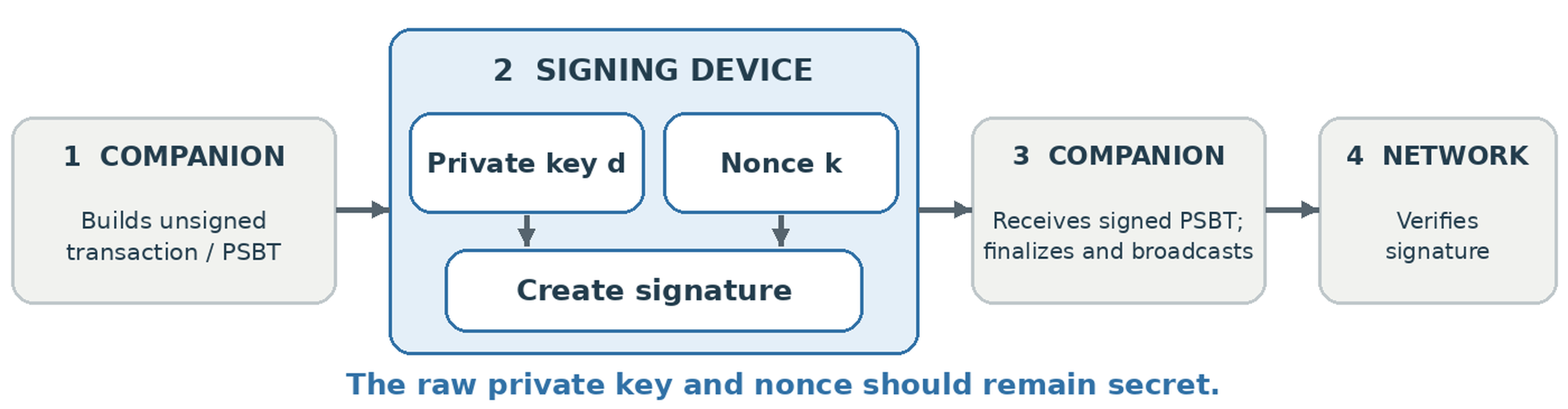
transaction data back to the companion wallet.
Think of a handwritten signature. There are countless slightly different ways you might sign your name, all of
which could still be recognized as yours. Someone controlling the way a signature is written could deliberately
introduce variations that communicate a hidden message to an accomplice without making the signature
appear invalid. The analogy is not exact, but it illustrates the freedom a Bitcoin signer has: many
mathematically valid signatures can authorize the same transaction, and ordinary verification does not explain
why the signer chose one rather than another.
The distinction becomes clearer when we consider the nonce, a temporary secret value used in the signing
calculation. Alongside the private key and the message being signed, the nonce helps determine the final
signature. It is not another password or recovery phrase that the user must preserve, and different signature
schemes generate or derive it in different ways. What matters is that its selection must be secure and that the
nonce remains computationally unpredictable to outsiders, even if it is derived deterministically: a revealed
nonce, or reuse of the same ECDSA nonce for different messages signed by the same key, can expose the
private key. More troublingly, software that deliberately controls the nonce can sometimes use that freedom
to encode hidden information in a signature that still passes ordinary verification.
This creates a counterintuitive possibility. A hardware wallet can display the correct transaction, generate a
signature accepted by the network, and give its owner no obvious indication that anything unusual has
happened, while the signature itself carries information an attacker knows how to extract. Because the
signature is intended to leave the device, the leak does not require the device to establish an internet
connection. An air-gapped wallet ultimately exports signatures by QR code, microSD card, or some other route,
and a malicious signer can potentially exploit that necessary communication. The device may be isolated from
the network, but the output of its signing operation is not secret.
What Dark Skippy Revealed
Researchers have studied the possibility of leaking secrets through apparently legitimate signatures for years.
The 2024 Dark Skippy research by Lloyd Fournier, Nick Farrow, and Robin Linus offered a particularly vivid
demonstration: malicious Schnorr-signing software could select deliberately weakened nonces derived from
fragments of a wallet seed, allowing someone who observed the signatures to perform additional calculations
and reconstruct the secret. In the researchers’ demonstration, as few as two signatures could be sufficient to
recover a 12-word seed. The significance was not only how little information the attacker needed, but how
normal the resulting transactions could appear to everyone else. [3]
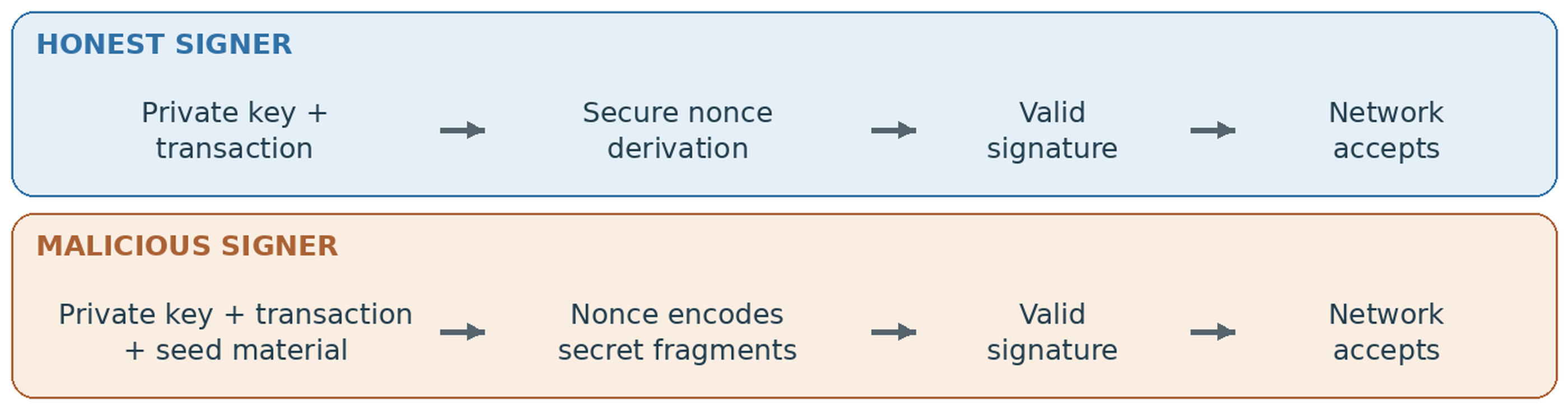
channel; Dark Skippy’s published demonstration used Schnorr.
Dark Skippy was a demonstration of a possible attack, not evidence that a commercial wallet had been caught
exploiting its users. Its published example concerned Schnorr signatures, while related risks involving nonce
manipulation also exist for ECDSA, which is used by traditional Bitcoin single-sig transactions. The research
therefore calls for careful distinctions rather than broad alarm. Air-gapping remains useful because it restricts
how a device communicates; a stateless design remains useful because it avoids retaining the seed between
sessions in a correctly implemented device. Neither property, however, can guarantee honest behavior during
the moment a private key is loaded and a signature is being produced. [3]
For us, the research presents an opportunity to take independent verification a step further. We already put
considerable effort into how a seed is generated, stored, and recovered; the behavior of the signer deserves
the same attention. The research gives us a clear direction for extending the independent testing that is
already central to responsible self-custody.
Why We’ve Built Signature Lab
At The Bitcoin Way, we believe leadership in self-custody means going beyond knowing which hardware
wallets to recommend. It means understanding how those devices behave, asking better questions when new
research exposes a gap, and contributing practical work that others in the space can examine and build upon.
When we recommend a hardware wallet, we’re asking someone to rely on that equipment to protect their
Bitcoin, potentially for decades. We take that responsibility seriously, from evaluating recovery options and
firmware behavior to investigating parts of the signing process that aren’t visible on the screen.
Many of the checks we perform are familiar. We can verify firmware, inspect receiving addresses, confirm
transaction details, and rehearse recovery with the client. Those are essential steps, but once a signing device
returns a mathematically valid signature, most ordinary workflows stop there. A valid signature establishes that
the transaction was cryptographically authorized by the corresponding key, but it does not prove that the
device followed an expected deterministic signing procedure or that the authorization reflected the owner’s
intent. We wanted to make that narrower, more difficult question easier to examine in a repeatable way.
Signature Lab stands on a foundation of valuable research and open-source development. Dark Skippy built on
earlier work into covert leakage through signatures, while developers focused on deterministic signing and
exfiltration testing created methods for investigating signer behavior. Entropy Lab provides a broad
environment for exploring Bitcoin cryptography, including signatures, and the open-source exfil-tester project
established comparison methods and reference algorithms on which Signature Lab directly builds. Building on
those contributions is how useful research becomes the starting point for further progress. [4] [5] [15]
The opportunity we saw was to turn that existing work into a focused, practical testing workflow. A
cryptographic method being available is not quite the same as making a specific test straightforward to run,
repeat, and investigate.
Signature Lab is designed to prepare synthetic test transactions with invented inputs, collect signatures from
hardware devices, compare them with independently calculated references under supported deterministic
methods, and preserve enough information to examine a discrepancy later. Bringing those steps together helps
us test different devices, repeat checks after firmware updates, and understand why something matched or
failed to match rather than relying on an unexplained indicator on a screen.
We also wanted the result to be something that another researcher could examine rather than simply take our
word for. The tool can reconstruct the transaction data used for signing, select a predetermined reference
policy, perform built-in reference checks, and retain evidence for offline replay. It examines the returned PSBT
as well as the signature, because a signer may communicate information in other transaction fields even when
its signature matches our expectations. These capabilities make it easier to distinguish an ordinary
implementation difference from a discrepancy that deserves further investigation. [15]
These comparisons can also reveal legitimate differences in how devices create signatures. Some differences
remain visible after a transaction is broadcast. We examine those fingerprints because a wallet should not
disclose more about its signing setup than a public transaction needs to reveal.
Designed to operate offline, Signature Lab uses synthetic test transactions and disposable secrets to examine
the signatures and associated transaction data returned by a signer. We’re already applying this approach
ourselves: members of our team have performed more than 50 internal Signature Lab test runs across the
devices we recommend, using the latest firmware available for each device at the time of testing and involving
multiple team members and setups. In those tests, the observed signing behavior matched the applicable
expected reference results. Those results strengthen our confidence in the behavior we tested, while we
remain clear that they do not certify a device or establish how it will behave under every possible condition.
The number of tests is only one aspect of that evidence. A useful test needs to exercise a case in which the
procedures we are comparing would actually produce different results; repeating a case in which all reference
methods agree tells us much less about which procedure a device followed. We discuss a concrete example of
this in the section on low-R grinding. Our reported results describe our internal testing experience, rather than
a representative study of every firmware version or an independent device certification.
Signature Lab remains an evolving project, and our internal tests are only one part of evaluating hardware
security. They do not replace independent review. We are making our methodology available for others to
examine, challenge, and improve because transparent methods and reproducible evidence are what give this
kind of work lasting value. Developing and sharing that capability is one concrete way we’re contributing to
stronger self-custody practices across the Bitcoin ecosystem.
What Signature Lab Can Tell Us
The underlying idea is straightforward, even if the cryptography behind it is not. When a deterministic signing
procedure is known, and a tester has the private key and transaction digest used in a test, an independent
implementation can calculate the signature that procedure should produce. Signature Lab compares that
reference with the signature returned by the hardware device. To make such a comparison possible without
exposing real funds, the test uses a deliberately disposable wallet whose private keys are known to the testing
environment. A real wallet seed must never be entered for this purpose.
In a typical supported workflow, the tester prepares a synthetic transaction using invented inputs rather than
actual spendable Bitcoin, loads the disposable seed onto an appropriate signing device, and asks it to sign. The
resulting signature, together with the Partially Signed Bitcoin Transaction (PSBT) containing it, is returned for
inspection; no Bitcoin needs to be sent, and the test transaction is not broadcast. [5] [15]
Signature Lab then distinguishes two questions that can easily be confused: whether the signature is valid for
the intended transaction, and whether it matches the result expected from a supported deterministic signing
method. The first question concerns cryptographic validity for the intended transaction digest, not whether the
synthetic transaction could be accepted by the live network. The additional comparison helps investigate the
second.
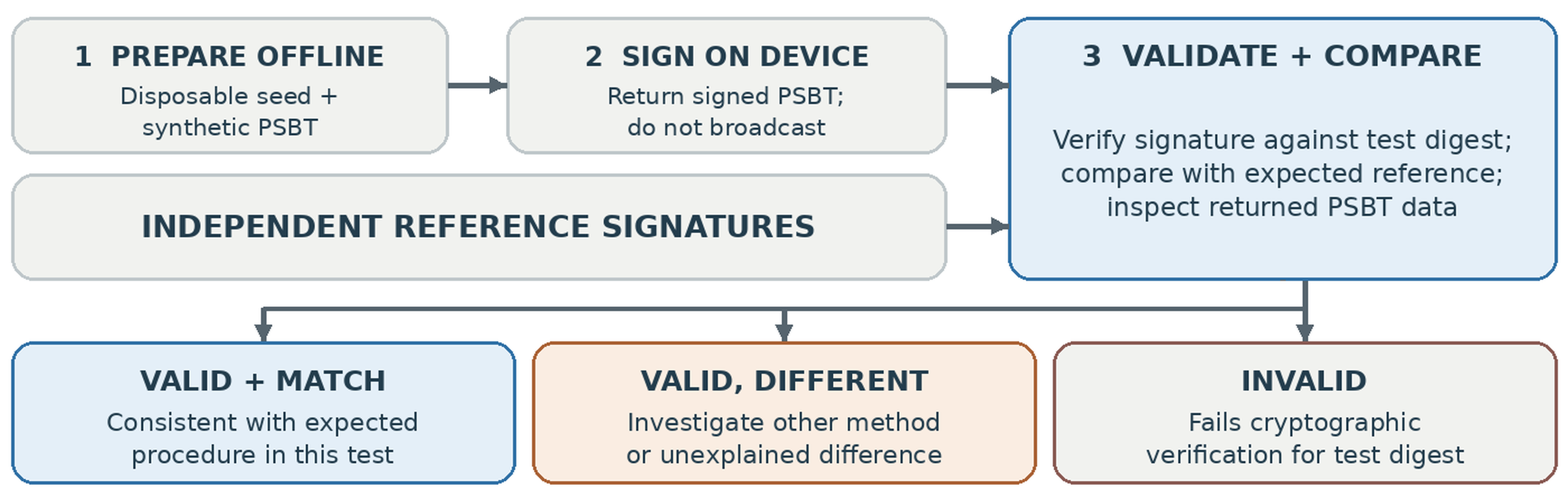
independently computed references. A matching signature with unexplained PSBT changes still requires review. The test does not
establish live-network spendability.
A matching result is meaningful because it shows that, under the conditions of the test, the device produced a
signature consistent with the expected procedure. A mismatch is also potentially useful, but it is a starting
point for investigation rather than proof of malicious firmware. Two honest devices can follow different
legitimate deterministic conventions, including techniques that search for signatures with more compact
encodings. Signature Lab accounts for several such approaches, checks for unexplained differences in returned
PSBT data, and allows evidence to be retained for review. The point is to understand observed behavior rather
than reduce a complex test to a reassuring green light or an alarming red one.
There are limits to what any controlled test can establish. A malicious signer could behave as expected during
controlled testing, then change its behavior under different conditions or in response to a specific trigger. A
saved test result also does not authenticate the physical hardware that produced it, verify its entire firmware,
or prove that its supply chain was secure. These are different problems, requiring different methods. We
therefore treat a passing Signature Lab result as evidence about the particular signing behavior observed, not a
guarantee about everything a device may do in the future.
These limitations do not diminish the value of the test; they define what its results can reliably establish. The
value of a security test lies in the clarity of the question it answers, the reliability of the method, and the
willingness to explain where its conclusions stop. Current development builds should only be used within the
project’s testing guidance: never expose a real seed, never fund a disposable test wallet, and never conduct
unapproved experiments on a production signer. If a device refuses a synthetic transaction, stop rather than
weaken its protections. Keeping the scope clear protects both the integrity of the research and the people who
might otherwise mistake an experimental tool for a comprehensive security endorsement.
Under the Hood: Why Deterministic Signing Matters
The following technical explanation describes the cryptographic comparison behind Signature Lab. Readers
who prefer the practical implications without the mathematics can skip ahead to “What Your Bitcoin Signatures
Reveal About Your Wallet.”
Traditional Bitcoin single-sig transactions, including BIP84 native SegWit spending, use the Elliptic Curve Digital
Signature Algorithm, or ECDSA. Taproot key-path spending uses Schnorr, a different signature scheme. The
current Signature Lab workflow focuses on ECDSA, and understanding that scope is essential when relating its
tests to the broader research discussed above.
The nonce is one of the secrets protecting the private key during signing. Although the public signature exposes
a mathematical relationship between those two values, an observer cannot ordinarily recover either secret. If
the nonce becomes known, however, a relationship involving two unknown secrets becomes an equation with
only one unknown: the private key. The mathematics below shows why.
ECDSA signing uses a private key, commonly written as d; a digest of the transaction data being authorized,
written as z; and a temporary secret nonce, written as k. The signature contains two values, r and s. Before any
low-S normalization, the fundamental ECDSA signing relationship can be expressed as:
s = k⁻¹(z + rd) mod n
Here, r is derived from the elliptic-curve point kG calculated using the nonce, n is the order of the curve’s
generator G, and k⁻¹ means the modular inverse of k. The essential point is not the notation but what it tells us:
the public signature is mathematically related to both the private key and the nonce. An attacker who learns
the nonce can rearrange this relationship to recover the private key, and nonce reuse across different
messages with the same key can create a similarly serious vulnerability. Secure nonce generation is therefore
not an obscure implementation detail; it is central to the protection of the key itself. [6]
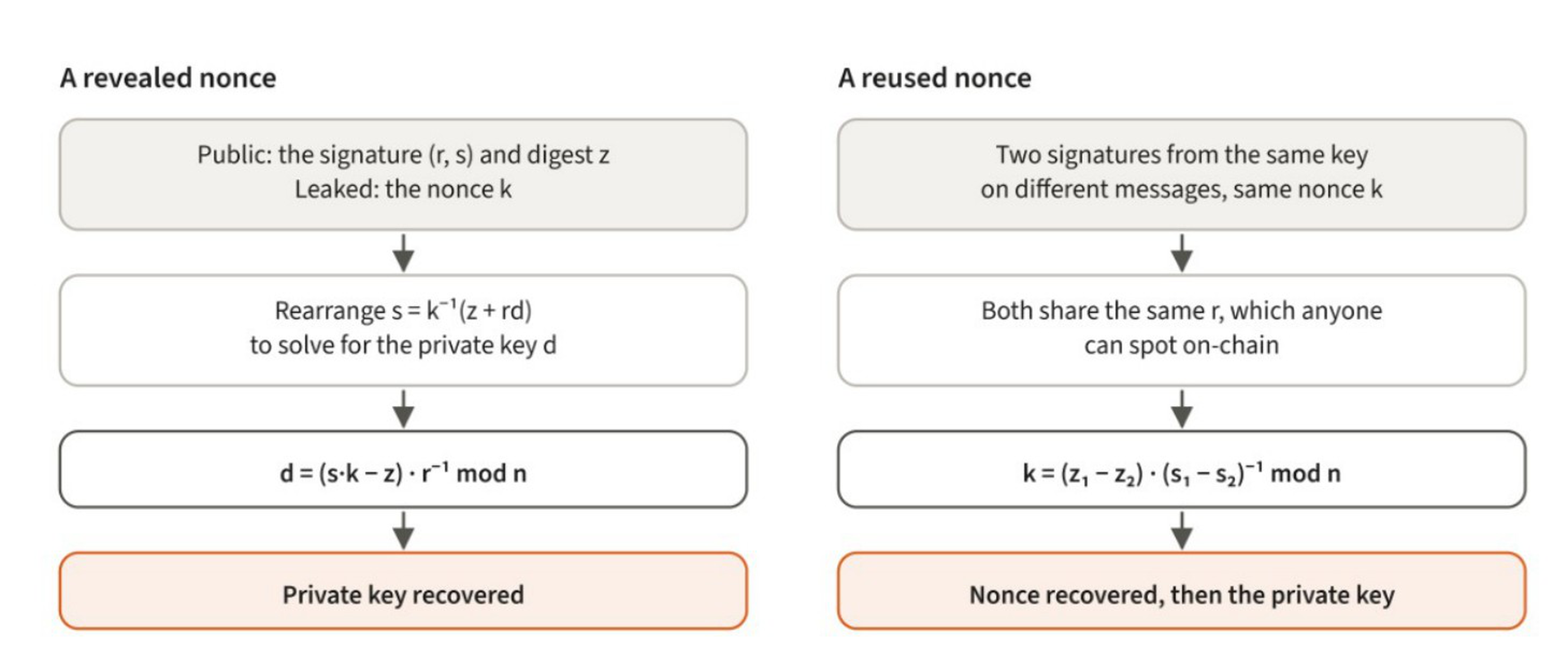
can do the same. The formulas illustrate the ECDSA relationship before low-S normalization.
One way to avoid reliance on fresh randomness for every ECDSA signature is deterministic signing, as described
by RFC 6979. An ECDSA signer can produce an enormous number of valid signatures for the same key and
message. Deterministic signing replaces arbitrary nonce choice with a defined recipe: the signer derives the
nonce from the private key and the digest of the message being signed. Two implementations using the same
inputs and precisely the same deterministic procedure, including nonce derivation, retry conventions, and
signature normalization, should arrive at the same signature, which makes independent comparison possible.
Since Signature Lab knows the disposable test key and the transaction digest, it can perform that reference
calculation and determine whether the hardware signer’s output matches. [6]
A malicious signing algorithm could itself be deterministic, so determinism alone is not a guarantee of honest
behavior. The advantage for testing is having a known, independently specified reference against which the
device’s output can be compared. Ordinary signature verification cannot provide that reference because it
accepts any signature that satisfies the verification rules.
There is an important complication: deterministic does not mean that every implementation must produce
exactly the same signature. Different legitimate conventions can alter the result, even though they produce
valid signatures and follow their own defined rules. Signature Lab currently supports specific approaches,
including standard RFC 6979, Bitcoin Core-style low-R grinding, and embit-style DER-length grinding. These
methods can involve trying additional deterministic nonce candidates to obtain particular signature-encoding
properties, so a meaningful comparison must account for the procedure being tested. Related work, including
draft BIP 461, reflects a broader interest in making ECDSA signing behavior reproducible and easier to evaluate
independently. [7] [15]
Bitcoin’s consensus rules do not require a signer to use one particular nonce-generation procedure. They ask
whether the signature satisfies the applicable verification rules, and multiple signatures can be mathematically
valid for the same key and message. Signature Lab investigates something different: whether the returned
signature is consistent with a specified deterministic method. That is also why we are precise about its
boundaries. Its supported workflow targets disposable BIP84 native SegWit single-sig wallets using ECDSA;
Taproot/Schnorr, multisig, BIP39 passphrases, randomized nonce schemes, and interactive anti-exfiltration
protocols are outside that workflow.
Because Dark Skippy’s published demonstration used Schnorr, Signature Lab should not be described as a
comprehensive Dark Skippy detector. It addresses a related question within a narrower, testable ECDSA model.
Deterministic signature comparison is not the only approach to limiting nonce-based exfiltration. In supported
workflows, interactive anti-exfiltration protocols involve the companion wallet in nonce generation. In a
commitment-based protocol, the signer commits to its own nonce contribution before an honest companion
wallet provides independently generated randomness; the companion subsequently verifies that the signature
reflects the agreed contribution. Proper verification matters because merely supplying randomness does not
help if a malicious signer can ignore it. These protocols require compatible device and wallet software and are
distinct from Signature Lab’s current offline comparison. [12]
The distinction between testing a device and constraining its behavior is important. Signature Lab is a
controlled inspection: we compare the work a device produces with an independently calculated result. Anti-
exfiltration instead changes the signing process itself, limiting a malicious device’s freedom over nonce
selection during a supported signing operation. Neither replaces ordinary signature verification, and neither
provides the same protection as distributing signing authority across independent keys. The different
approaches address different questions.
Not every difference in signing behavior is a security concern. Some result from legitimate implementation
choices, but those choices can still affect what an observer learns from the signatures a device produces.
What Your Bitcoin Signatures Reveal About Your Wallet
A signature should prove authorization—not advertise your wallet
When you broadcast a Bitcoin transaction, the signature needs to prove that the spending key authorized it. It
does not need to advertise whether the signer was a SeedSigner, a Coldcard, a Jade, or another wallet. We
want the devices we recommend to protect private keys without adding unnecessary clues about the people
and setups behind their transactions.
That is a goal, not a promise of perfect anonymity. Public transactions already contain information, and neither
Bitcoin Core-style signing nor any one hardware wallet can make all other fingerprints disappear. Still,
removing a distinctive signature pattern can avoid giving an observer one more piece of information to
combine with everything else they know.
Why an extra clue can matter
Imagine receiving an anonymous printed letter. The words might reveal nothing about who wrote it, but the
typeface, formatting, and paper could offer clues about the equipment or software used to produce it. None of
those characteristics necessarily identifies the sender, yet they can become useful when combined with
information from elsewhere. Bitcoin transactions have a similar property: details that are incidental to what a
transaction accomplishes can still say something about how it was created.
Wallet software may leave patterns through coin selection, input and output ordering, change handling, and
transaction defaults. Researchers have shown how combinations of transaction characteristics can support
guesses about the software that created them. Signature length is another possible clue, especially when
multiple transactions are linked to the same wallet. That research does not establish that signature lengths
alone identify individual hardware-wallet models. [10]
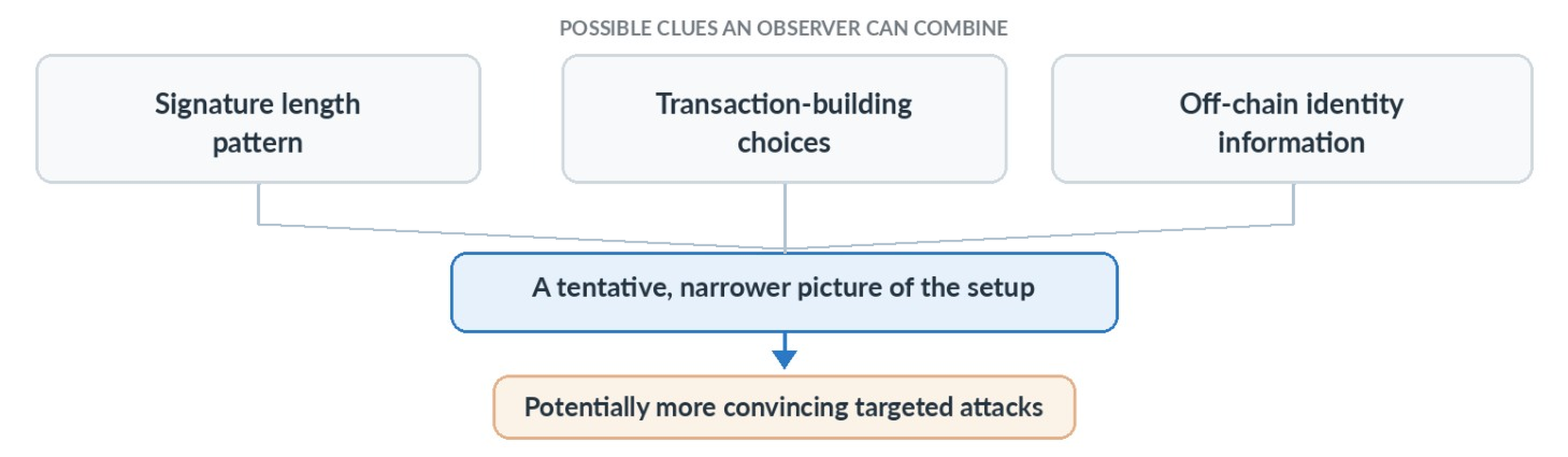
Imagine an attacker who already has a person’s identity from a payment relationship, a data breach, or other
off-chain information. If on-chain clues help narrow the wallet software or device family that person might use,
a tailored firmware-update scam or fraudulent support message could become more convincing. This does not
mean a high-R signature reveals a seed, a name, or a vulnerability. It means that avoiding information you do
not need to reveal is a sensible privacy objective.
The one-byte difference: low-R grinding
Bitcoin’s signature rules answer a deliberately narrow question: does this signature authorize this transaction?
They do not prescribe how the signer must create it. Two devices can use the same private key to sign the
same transaction and produce different, equally valid ECDSA signatures, because each signature also depends
on a temporary secret called a nonce. We’ve already seen why that freedom matters for security. It also means
that honest devices can reveal something about their implementation in the signatures they leave behind.
An ECDSA signature contains two numbers, r and s. Bitcoin encodes them in a format called DER, which treats
integers as signed. If the most significant bit of the minimal unsigned encoding of r would make the number
look negative, DER adds a zero byte to make its meaning unambiguous. For a typical 32-byte r derived from an
ordinary nonce choice, that happens roughly half the time. The extra byte doesn’t weaken the signature or
change what it authorizes; it is simply how the number must be represented. With the usual low-S convention,
it accounts for the familiar difference between typical 71-byte and 72-byte signatures in native SegWit,
including the sighash byte. There are rare exceptions when r or s takes fewer bytes than usual.
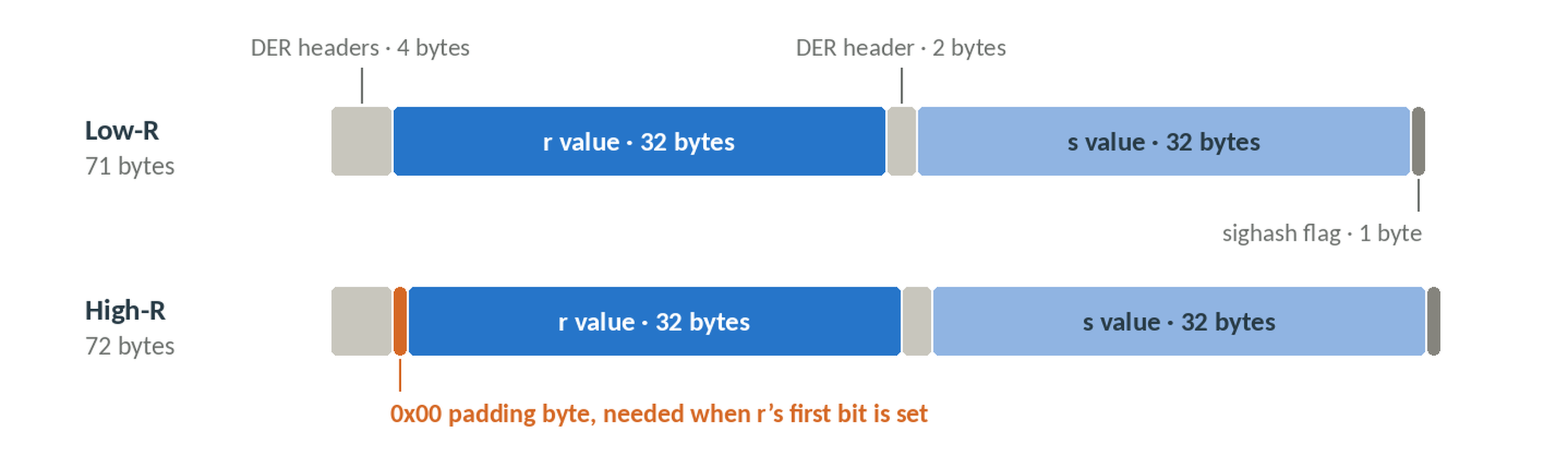
when the other integer has its usual length.
Bitcoin Core makes a deliberate choice about that extra byte. When its first deterministic nonce produces a
high r (r ≥ 2²⁵⁵), it tries another candidate until r is below 2²⁵⁵. This is low-R grinding. It isn’t deleting a byte from
a finished signature: changing the nonce produces a different, equally valid signature, whose r value happens
to fit more compactly. Since about half of candidates already satisfy that condition, it takes roughly two
attempts on average. Bitcoin Core introduced this convention in version 0.17 in 2018. The fee saving is small,
but the privacy implication is more interesting: a signer that grinds according to the same convention as other
implementations avoids one difference from those wallets, while a signer that accepts the first nonce
candidate can leave a different on-chain pattern. [7] [8]
Three methods, but only two broad signature-length patterns
Published hardware-wallet research distinguishes three legitimate signing approaches. Their underlying
security properties differ, but the blockchain does not reliably display three separate fingerprints. The
sequences below are illustrative, not results from our tests. [9]

length alone does not prove low R or anti-exfil use.
A single compact signature tells an observer very little. A non-grinding signer can produce low R on its first
attempt about half the time. But if ten independent signatures from the same signer all have low R, the chance
of that pattern under ordinary non-grinding is about one in 1,024. Repeated observations can therefore
support an inference about the signing method, even though they still cannot name the device or firmware.
One in 1,024 is the probability of observing the pattern under the non-grinding hypothesis, not the probability
that the hypothesis is true. Estimating the latter would require knowing how common the competing signing
methods are and how reliably the signatures can be attributed to the same signer. There are important limits:
ten signatures of the same message are not ten independent trials, and blockchain analysis may not reliably
establish that different transactions used the same signer. A high-R value also contradicts strict low-R grinding
for that signature; a low-R value alone proves nothing about whether grinding took place.
method for identifying a particular hardware wallet or its owner.
Why matching Bitcoin Core can help you blend in
Bitcoin Core’s strict low-R convention is a useful reference because it is an established convention shared by
Bitcoin Core and other implementations. The privacy benefit comes from sharing that convention with others,
rather than from uniformity alone. If the companion wallet constructs a transaction with characteristics also
shared by Bitcoin Core, a signer using a distinctly different signature-length pattern may add an avoidable clue.
Matching Core’s low-R behavior does not establish anonymity or make transactions indistinguishable in every
respect; it simply avoids that particular difference.
Coldcard offers a concrete example. In 2021, Sparrow developer Craig Raw noticed that its signatures differed
from Bitcoin Core’s. Coinkite added low-R grinding in firmware 4.1.2, credited the observation, and expressly
noted the on-chain anonymity benefit of making its signatures consistent with Bitcoin Core. That is the point
worth emphasizing: an observable fingerprint was identified and reduced, without changing the fact that both
signing methods could produce valid Bitcoin signatures. [11]
What research and device testing tell us
A 2026 study examined particular hardware wallets, firmware versions, and companion-wallet configurations.
The results show why implementation details matter, but they are snapshots, not permanent product labels.
Our internal Passport Prime finding is separate from that published study, and the KeyOS 1.4.1 source code
independently corroborates low-R grinding in its standard ECDSA PSBT-signing path. The table distinguishes
published observations, our internal finding, and source-code evidence.

The firmware versions in the table refer to published testing or, where specified, source-code review. KeyOS
1.4.1 identifies the reviewed source, not necessarily the build used in our internal hardware tests. Similarly, the
Coldcard Q entry reflects shared firmware code, not a separate published Q hardware test. Companion
software and firmware updates can change the picture. [9] [16] [18]
SeedSigner shows why a compact signature isn’t necessarily a Bitcoin Core signature. Bitcoin Core specifically
targets r below 2²⁵⁵. SeedSigner uses the embit library, which instead looks for a DER encoding of the signature
as a whole of 70 bytes or fewer (before the sighash byte), subject to a retry limit. Most of the time those
choices lead to the same visible result. But DER also encodes s, the signature’s second number. On rare
occasions s needs one fewer byte, which can offset the extra byte required by a high-R value. In that case,
embit can accept a signature that is short overall even though r isn’t low.
Neither implementation is wrong, and both can be reproducible. But a 71-byte signature alone doesn’t tell us
which procedure produced it; we need to inspect the encoded values and compare the result with the correct
reference. [9] [17]
Privacy fingerprints are not verdicts on signing security
Some wallets use interactive anti-exfiltration signing. With compatible, honest companion software that
properly verifies the signer’s commitment, it involves the companion wallet in nonce generation and reduces a
malicious signer’s freedom to hide secrets in signatures. The resulting ECDSA signature lengths may still be
mixed. That observable difference should not be mistaken for weaker protection: meaningful anti-exfil security
can matter far more than eliminating a one-byte fingerprint. [12]
This is why we do not rank hardware wallets by low-R behavior alone. Privacy, resistance to nonce
manipulation, supply-chain considerations, firmware integrity, ease of recovery, and the overall custody design
all matter. A single-sig user depends on one signing key, making those tradeoffs particularly important; multisig
does not remove the need to examine each signer.
What Signature Lab contributes
This is where Signature Lab becomes useful. Bitcoin will tell us whether a signature is valid; it will not tell us
whether the signer followed the procedure we expected. With a disposable key and an unfunded test
transaction, we can calculate the signature that a specified deterministic method should produce and compare
it with the device’s output. Signature Lab supports reference methods including ordinary RFC 6979, Bitcoin
Core’s low-R grinding, and embit’s DER-length approach. That lets us investigate what the device actually did,
rather than guessing from a signature’s length.
The test cases matter. If the first ordinary nonce already produces low R, the output of a non-grinding signer
can be identical to Bitcoin Core’s. To distinguish the methods, we need at least one test in which their expected
signatures diverge. The same principle applies when distinguishing strict low-R grinding from embit’s DER-
length approach: a compact result is not enough if both reference procedures would have produced it. Even
then, the conclusion has limits: a device might behave normally with a disposable key and differently with a
real one. A matching result is evidence about the procedure observed in that test, not proof against every
possible covert leak or a replacement for interactive anti-exfil protection.
The principle is simple: a Bitcoin signature should establish authorization without unnecessarily advertising
how or where it was created. We cannot eliminate every on-chain clue, and we should not sacrifice stronger
signing protections merely to match a popular pattern. But we can understand the clues, avoid preventable
ones, and use repeatable evidence to make better recommendations. That is why the low-R question matters—
and why Signature Lab belongs in the conversation about both security and privacy.
From Research to Better Recommendations
For many of our clients, SeedSigner remains our preferred starting point. We value its open-source software,
stateless design, and QR-based communication because those properties address risks we care about: the
device is not intended to retain a seed after shutdown, and its communication path can be kept comparatively
simple and observable. At the same time, the signing concerns described in this article remind us not to
confuse a useful design property with universal protection. A stateless device can still misbehave while a seed
is loaded, and an air-gapped device must still export its signatures. Recognizing those boundaries makes our
reasons for recommending SeedSigner more precise, not less compelling.
We also recommend Blockstream Jade and Foundation Passport Prime when their particular tradeoffs better
suit the client and the intended wallet design. Signature Lab helps us evaluate differences in how these devices
sign, including conventions that can leave observable traces on-chain. We would rather avoid unnecessary
fingerprints that could help narrow down someone’s wallet setup, while recognizing that a stronger signing
protection can justify a different observable pattern. These findings are only part of a broader assessment. The
right choice depends on how someone will operate the device, what recovery would look like, which
communication methods they prefer, and how the overall custody arrangement is constructed. Our
responsibility is to understand those differences and explain them clearly, rather than assuming that our
preferred device is automatically the best device for everyone.
Our work goes beyond selecting devices and explaining how to use them. We test hardware ourselves, revisit
our findings as firmware changes, and follow independent research closely enough to improve our methods
when the evidence calls for it. Our internal Signature Lab results give us useful grounds for confidence in the
behavior tested, and the project’s defined limitations keep those conclusions precise. By inviting technically
capable users and developers to examine the methodology, repeat appropriate tests, and improve on the
work, we hope to make the contribution useful beyond our own clients. A strong security conclusion should be
able to withstand examination.
A single-sig wallet can be an excellent long-term choice when its seed is generated securely, its backups and
any passphrase are managed responsibly, the signer is selected with an understanding of its limitations, and
recovery is planned before an emergency. Multisig can be the better choice when its additional protections
warrant the work of maintaining multiple keys and the information needed to recover them. Both approaches
deserve to be judged by the same standard: whether they address the actual risks and remain usable by the
people who will depend on them.
Helping Raise the Standard for Self-Custody
Bitcoin gives us the ability to independently verify the rules governing our money, and we believe that same
mindset should extend to the tools we use to protect it. We already ask important questions about how private
keys are generated, where they are stored, and how they can be recovered. Signature Lab is our contribution
to making what happens when those keys are used more accessible, measurable, and open to independent
scrutiny.
Ultimately, the value of this work is measured in practical results: carefully chosen devices, recovery plans
people can actually follow, and clients who understand the safeguards built into their setups. Our clients
should not need to become cryptographers to benefit from advances in cryptography. The research matters
because it improves the decisions we make and the guidance we can provide.
The same principle guides how we evaluate hardware. We don’t simply repeat a manufacturer’s security claims
or treat a device’s reputation as the end of the conversation. We test assumptions, revisit our conclusions as
technology changes, and look for ways to make difficult security questions easier to investigate. Signature Lab
is a tangible contribution to that effort. It gives us another way to examine whether a device follows an
expected signing procedure and whether its normal signatures add avoidable clues about the wallet behind a
transaction. We want to protect the private key and minimize unnecessary information disclosed on-chain,
without confusing a privacy fingerprint with proof of insecurity. Signature Lab does not eliminate every
vulnerability or replace the fundamentals of good self-custody, but it advances the questions we can ask and
the evidence we can gather.
This is the standard we’re helping to raise at The Bitcoin Way. We want to contribute more than advice by
improving the tools, methods, and expectations that shape Bitcoin security. Each test and each lesson from
new research helps us serve our clients better while giving the wider community something useful to examine
and build upon.
Trust matters when someone is protecting their Bitcoin, and that trust should be grounded in work that stands
up to scrutiny. Our clients can count on us to stand behind our recommendations, explain the reasoning behind
them, and keep improving our approach as the technology evolves. Signature Lab reflects that commitment.
We’re not only helping people use the tools available today; we’re contributing to the work that can make self-
custody stronger tomorrow.
Single-sig isn’t dead. Blind trust should be.
Explore Signature Lab on GitHub, or speak with The Bitcoin Way about a custody setup suited to your needs.
References
Research, standards and source documentation
Citation numbers link directly to source material. Titles below are also clickable.
[1] COLDCARD seed-generation security advisory — Coinkite | July 2026 disclosure and guidance
[2] Ledger confirms CryptoBilis hardware implant — CoinDesk | October 2026 reporting
[3] Dark Skippy: original research and FAQ — Lloyd Fournier, Nick Farrow and Robin Linus | 2024
[4] Entropy Lab — open-source project — OogaBoogaX | Offline Bitcoin cryptography and wallet tools
[5] exfil-tester — open-source project — oren-z0 | Disposable-PSBT deterministic-signature testing
[6] RFC 6979 — Deterministic DSA and ECDSA — Thomas Pornin | August 2013
[7] BIP 461 — Deterministic ECDSA Signatures — Bitcoin Improvement Proposal | Draft specification
[8] Low-R grinding — Bitcoin Optech | Technical overview and adoption history
[9] Is Hardware Wallet Fingerprinting Even Possible? — DISCRYPT | 2026 hardware-wallet testing
[10] Wallet Fingerprints: Detection & Analysis — Ishaana | Transaction construction and fingerprinting
research
[11] COLDCARD version 4.1.2 release notes — Coinkite | July 2021 low-R implementation
[12] Dark Skippy — mitigation approaches — Dark Skippy research team | Interactive anti-exfil protocols
[13] COLDCARD Security Update: Seed Generation, Transaction Integrity, and Data Isolation — Coinkite | Mk4,
Mk5 and Q remediation
[14] Update on the Hardware Implant Incident Investigation — Ledger | Updated November 19, 2026
[15] Signature Lab — open-source project — The Bitcoin Way | Supported test methods, scope and evidence
replay
[16] Passport Prime — KeyOS v1.4.1 signing path — Foundation Devices | PSBT signing and pinned BDK signing
implementation · Dependency lockfile · BDK signer code
[17] embit ECDSA signing implementation — diybitcoinhardware | DER-length grinding and retry limit
[18] COLDCARD firmware version history — Coinkite | Mk4 and Q shared codebase