
The Signal Most People Will Ignore

In this article:
If you own Bitcoin, hold investments, run a business, or have ever considered leaving your country before the rules get worse, the European Commission’s new study on wealth taxation should have your full attention.
While you were quietly stacking sats, the clowns in Brussels were busy sharpening the knives.
Laws don’t just appear out of thin air. They start as boring research papers, expert panels, impact assessments, and carefully worded bureaucratic sludge. By the time it hits the headlines, the real work is already done. The assumptions are locked in. The vocabulary has been softened. The machinery is already being built.

That’s what makes this report important.
The study examines wealth taxes, capital gains taxes, inheritance taxes, taxes on unrealized gains, and exit taxes; the whole menu. It also looks at the administrative systems needed to make those taxes work: asset registers, third-party reporting, digital tax enforcement, specialist units for high-net-worth individuals, and international information exchange.
In plain English? Brussels is studying how to identify what you own, decide what it’s worth, tax gains you haven’t sold, and stop more people from slipping away.

Most people will miss the signal because they’re busy, distracted, and because this is “just research”, right? That’s how these things hide in plain sight. The real intent sits underneath the tax: the system that identifies the asset, slaps a number on it, links it to you, and keeps you in reach.
That’s why this paper matters. It shows the thinking before the trap is sprung.
The Sovereign Individual, a classic book for Bitcoiners, warned that the information age would break the old tax model. In the industrial era, governments treated productive people like dairy cows in a field. The cows were easy to locate, easy to milk, and easy to fence in because work, wealth, banking, and identity were tied to physical territory.

Then technology gave the cows wings. Bitcoin, encryption, remote work, digital businesses, and jurisdictional arbitrage changed the equation. Capital became more mobile. Talent became more mobile. Wealth became harder to hold inside one national pen.
The EU report reads like the farmers’ summit on wing-clipping technology. How do you keep milking the herd once the herd can fly? You build better tracking collars. You monitor the movement. You tax the flapping of wings. You install toll booths at the gates. You call the whole thing fairness.
Governments can see that the old model is weakening. They know that productive people have more options than they used to. They know that Bitcoiners, entrepreneurs, investors, and mobile families can increasingly choose where to live, where to build, and where to be taxed. So the state is adapting.

The EU isn't studying exit taxes because it's curious. Regulators don't spend years modelling escape routes for intellectual exercise. They study them because they understand the threat; when productive people can leave, the tax base becomes negotiable.
Exit taxes are the toll booths at the edge of the field. They are the State’s way of saying, “You can leave, but first we’ll price the door”.
If you're waiting for the “right time” to restructure your jurisdictional exposure, understand this: the people building the framework aren't waiting. The right time was yesterday.
They Created the Wealth Gap, Now They Want to Tax the Escape Route
The sales pitch is fairness.
The report leans hard on the usual sob story: private wealth has exploded, the rich have pulled even further ahead, workers are getting crushed, and therefore the tax system simply must respond. The wealthy own too much. The little guy carries too much. Governments need more revenue. Wealth must finally “pay its fair share”.
It sounds compassionate. It borrows all the right words about justice. Nobody wants a rigged game. Nobody wants asset owners floating away on yachts while everyone else drowns in rent, energy bills, groceries, and wage taxes. But here’s the question nobody in Brussels wants you to ask: who the hell rigged it in the first place?

The wealth gap didn’t appear from nowhere. It is a product of the same monetary and political class now asking for more power to fix it. Years of cheap money, deficit spending, bailouts, bond-buying, and central-bank intervention pumped trillions straight into the pockets of those closest to the money printer.
New money never rains down equally. It enters through the institutions closest to the source: governments, banks, insiders, and corporations with connections. They touch the new money first, buy before prices adjust and refinance cheaply. They watch their portfolios, properties, and scarce assets rise.

Everyone else meets the same money later as inflation. Higher rent, higher food prices, higher house prices, and lower purchasing power. A harder climb onto the first rung of the asset ladder.
Then, after years of pouring gasoline on the fire, the same people point at the smoke and call it a social emergency. That’s the trick. The state helps create the inequality through monetary distortion, then uses that inequality as the moral permission slip for a bigger tax-and-surveillance machine.

This is why language matters. “Fairness” sounds harmless until it becomes asset registers, reporting obligations, annual valuations, unrealized gains, and exit taxes.
And once the moral case has been accepted, the argument moves quickly. First it’s about billionaires. Then it’s about the top one percent. Then it’s about anyone with enough assets to be worth tracking. Then it’s about anyone mobile enough to leave before the bill arrives.
Before They Tax It, They Have to Make You Legible
Remember the tax bill is never the first move. The first move is making you legible.
That means turning your assets, movements, accounts, gains, losses, identities, companies, wallets, and relationships into clean records the state can read. Once that happens, the rest becomes easier. A tax demand becomes a calculation. An audit becomes a workflow. An exit becomes a taxable event.
This is the unspoken part of the new wealth-tax agenda. Nobody panics over “administrative capacity”. Nobody forwards a viral article about valuation standards. Nobody restructures their life because a report mentions better cooperation between tax authorities.
The real control layer isn’t Ursula von der Leyen grandstanding on television promising to make billionaires “pay their fair share”. It’s the database behind her. It’s the reporting rule your bank follows. It’s the exchange sending forms to the tax office. It’s a foreign institution sharing account data. It’s the valuation model that turns your unsold asset into taxable “income”.
Bear in mind that this isn’t just a Brussels problem. Europe may be one of the loudest laboratories, but the reporting architecture is already globalising. DAC8, the EU’s crypto-reporting regime, is built on the OECD’s Crypto-Asset Reporting Framework, which extends the old automatic tax-information-sharing model into digital assets. In other words, the same club that helped normalise cross-border bank reporting is now helping governments make Bitcoin activity more visible too. So don’t assume this can’t reach you because you live outside the EU.

We covered this in Sovereignty Doesn’t End at Self-Custody: broke, desperate governments don't become more respectful of your freedom. They become more hostile to anyone with savings, mobility, and the ability to opt out.
If you hold Bitcoin, your mind probably goes straight to custody. Can they take my coins? Can they crack my seed phrase? Can they force me back onto a regulated exchange?
The better question is: can they attach your Bitcoin to your legal identity, your tax residence, your banking history, your exchange records, your property purchases, your company structure, or your attempt to leave?

Because once your wealth is attached to you in the system, the state doesn’t need to touch your private keys to make your life painful. It can tax the gains, question the source of funds, block clean exits, impose penalties, and the list goes on.
That is why the online identity push belongs in the same conversation. The Commission is actively pushing Member States to roll out age-verification systems by the end of 2026, either as standalone apps or integrated into the European Digital Identity Wallet. The sales pitch is child safety and privacy. This is the same psychological tactic: framing wealth reporting as a matter of fairness.

The state doesn’t need to know everything at once. It just needs enough connected records to make anonymity impractical. That’s the modern counterattack against sovereignty.
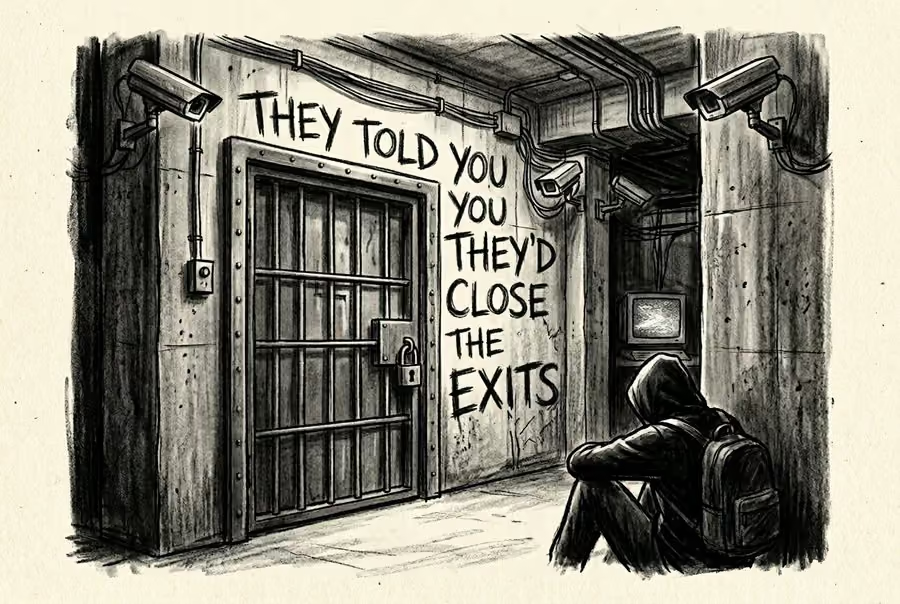
Technology has made people more mobile. Governments are responding by making mobility more documented. The goal is to rebuild the old cage without making it look like a cage. No wall or border guard. Just accounts, apps, forms, reporting obligations, and penalties waiting in the background.
The future tax system won’t kick your door down. It’ll just send the bill to the right address.
Unrealized Gains Are the Line You Were Told They Wouldn’t Cross
This is the part that should make every Bitcoin holder sit up.
You didn’t sell a single sat, didn’t cash out, didn’t flee back into fiat, and didn’t receive any income at all. The number on the screen went up, and the state wants a piece of it. That’s the ugly, twisted logic behind taxing unrealised gains. It turns holding into a taxable event. It treats patience like income. It punishes you for owning the thing before you’ve actually taken profit.
For years, people assumed this line wouldn’t be crossed because the objections are so obvious. What happens if the asset crashes next year? What happens if you don’t have the cash to pay? Who decides the value? How does this work with volatile assets? How does this avoid becoming an annual punishment for holding scarce assets?

The EU report knows all of this. It casually calls recurrent taxes on unrealized gains a “conceptually coherent” fix for the problems of normal capital gains tax (especially the “lock-in effect” where people refuse to sell because of the tax hit). Translation: if people won’t sell and trigger a tax, just tax them before they sell. Problem solved, right? They also admit it improves “horizontal equity” between labour income and capital income; this is bureaucratic speak for “we want to make capital easier to hammer”.
Then the report admits the problem. Broad accrual taxation is hard because it requires frequent, reliable valuations across different assets. Non-listed businesses and real estate are difficult to price. Volatile asset values create liquidity and fairness concerns when people are taxed on paper gains that may later disappear. But don’t take comfort from that.

When regulators openly study the obstacles, they’re also studying the workarounds: smoothing mechanisms, deferrals, narrow asset classes, better reporting, improved valuations, greater administrative capacity. More ways to drag paper wealth into the tax base without calling it what it is: a tax on money you haven’t made yet.
Bitcoin is where those workarounds become easier. A private business is hard to value. Art is subjective. Property can be argued over. Bitcoin trades 24/7 on global markets. The price is visible. The asset is liquid. And if you bought through a KYC exchange, the paper trail may already exist.

That doesn’t mean every government can easily tax every self-custodied coin tomorrow. But it does mean Bitcoin holders should stop pretending they aren’t coming for their sats.
The Netherlands Is the Warning Shot
The Netherlands has already dragged this absurdity out of theory and into politics. Its Box 3 reform was adopted by the House of Representatives on 12 February 2026 and is aimed at 1 January 2028. We covered this insanity before in Taxing Phantom Profits - The Netherland’s War on Wealth.
The new system moves toward taxing actual returns on savings and investments, using capital gains treatment for some assets and capital growth taxation for others. In practice, that means annual value increases on many assets can enter the tax base before anything has been sold.

The defense is predictable. Officials and advisers present this as a necessary replacement for the old Box 3 system, a way to prevent long-term tax deferral, simplify administration, and protect revenue. They’ll say it can be made workable with loss relief, exemptions, and technical fixes. But that’s the tell. If taxing paper gains wasn’t hostile to capital, they wouldn’t need special treatment for real estate, carve-outs for start-up shares, loss-relief mechanisms, Senate amendments, and endless reassurance just to keep the thing alive.
The backlash has already started. A petition against the Dutch Box 3 law has reportedly gathered more than 61,000 signatures, the Senate has sent 36 pages of questions to the tax minister, and the government is now exploring amendments around loss carry-back and start-up exemptions. Notice the response. They aren’t ripping up the idea. They’re sanding down the sharp edges so the machine can still run.
And once governments start taxing the number on the screen, the next question becomes obvious: what happens when you try to leave before the bill gets worse?
Exit Taxes Are Designed for People Who Wait Too Long
Exit taxes are the state’s answer to Plan B because governments understand that when the rules become hostile enough, people with options start looking for the door. So the state prices the door.
The EU report describes exit taxes as applying to unrealised capital gains built up during residence when taxpayers or assets move abroad, with the purpose of protecting the domestic capital gains tax base. Strip away the bureaucratic fog and the message is simple: “You made that gain while you were living here, so we want our cut before you walk away”.
They don’t need to stop you from leaving forever. They only need to make leaving late painful enough that most people stay, comply, and hope the next rule isn’t worse. This is why waiting for certainty is a losing game. Most people want the final law, the final rate, the final threshold, and the final implementation date before they act. They want the threat confirmed, signed, announced, explained, and digested by their accountant. But certainty is expensive.
By the time everyone agrees the threat is real, the easy moves are usually gone. Research has become consultation, consultation has become draft legislation, draft legislation has become implementation guidance, and guidance has become a deadline with an exit bill attached.
That is how the window closes. It doesn’t usually happen in one sudden moment, with soldiers at the border or some cartoon villain speech from a finance minister. It happens through paperwork, timelines, compliance notes, tax guidance, and the slow normalisation of rules that would have sounded insane ten years earlier.

Exit taxes are the Berlin Wall for capital. They don’t need concrete or barbed wire when a calculation can do the job. If the number is large enough to make leaving feel reckless, the wall has already worked.
And that is exactly the point. A taxpayer with no exit is a subject, while a taxpayer with options is a customer. Broke governments hate customers because customers compare prices, leave bad service, and refuse to accept endless tax hikes, frozen thresholds, wealth reporting, paper-gain taxation, and moral lectures from the same political class that inflated the mess in the first place.
So the state’s response is predictable: make wealth visible, gains taxable, identity verifiable, and leaving costly.
This is why Plan B isn’t something you build after the rules change, because by then you may be planning inside a framework designed to punish exactly that move. You build it before you need it, while you can still act under today’s rules instead of tomorrow’s restrictions.

We’ve already shown what this looks like in practice in An Adventure in Panama: Plan B isn’t an abstract theory or some luxury fantasy. It is paperwork, process, jurisdictional choice, and the relief of knowing you have another legal option before you need one. It is much easier to build that option calmly than to chase it once everyone else has realized the same door matters.
If you’re serious about protecting your family, your mobility, and your jurisdictional options, book a 30-minute consultation with one of our Plan B experts. We’ll help you understand your second-residency options, assess your exposure, and take practical steps before the window narrows.