

Who Decides When You Can Withdraw Your Bitcoin?
In this article:
Is some (or all) of your Bitcoin still sitting on an exchange?
If it is, I’d guess one of the following is the reason:
- It’s where I bought it.
- I can sell it quickly if I need to.
- It’s a large, well-known regulated exchange. I think it’s safe.
- Self-custody is complicated. I don’t trust myself not to mess it up.
Broadly speaking, the reasons usually fall into one of three categories: convenience, trust and fear.
The first two, convenience and trust, only work if the exchange does its job.
And at the end of October, the world’s largest exchange didn’t.
The world's largest exchange closed withdrawals
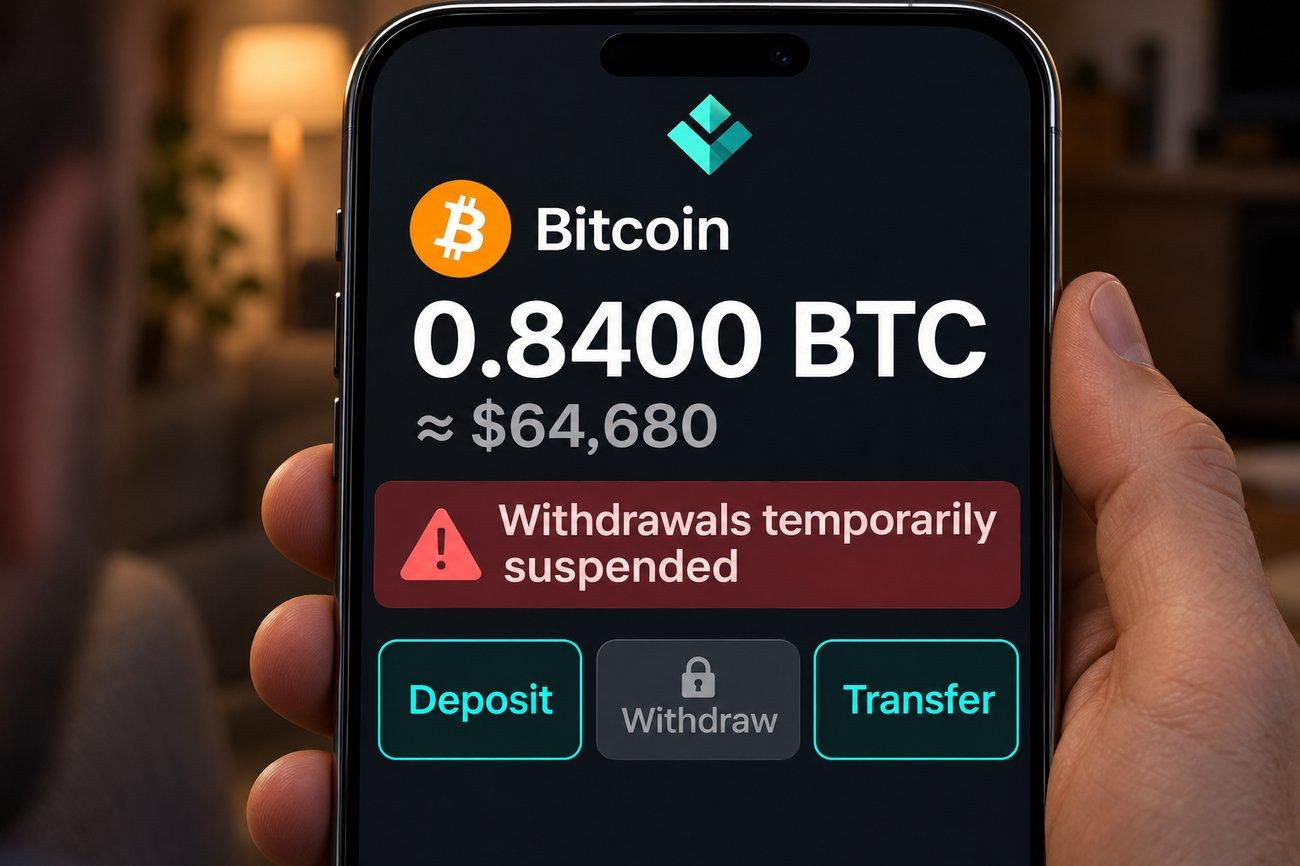
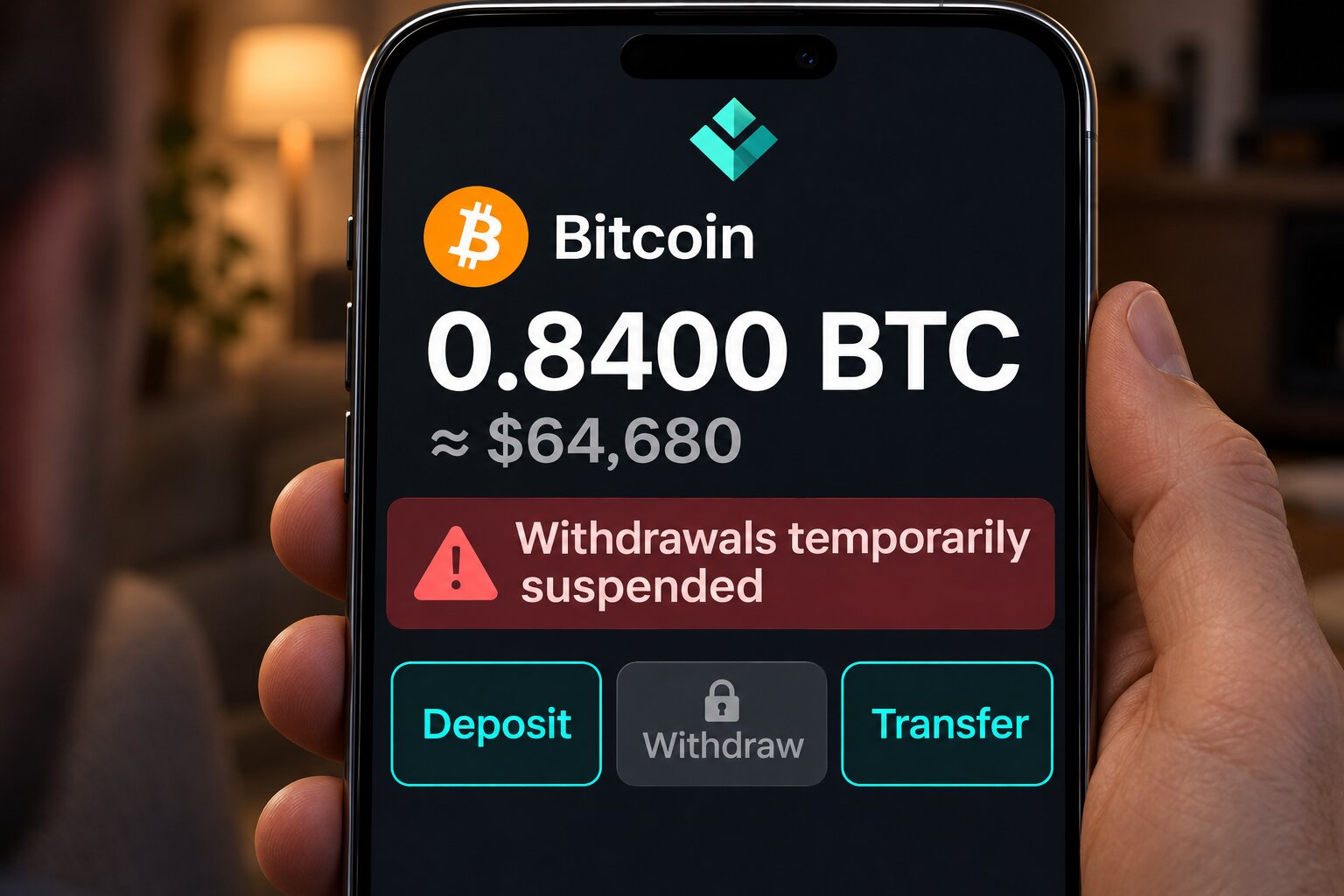
Picture this. You hold your Bitcoin on an exchange. One day you read online rumours that the exchange is in trouble.
You open the app on your phone, ready to transfer your holdings elsewhere. But the ‘Withdraw’ button is now greyed out.
You get an email saying all withdrawals are suspended until further notice.
For Binance customers, that’s exactly what happened on 29 October.
The world's largest exchange suffered a hack, resulting in the biggest loss ever recorded.
In about 20 minutes, crypto and Bitcoin worth $6.3 billion left Binance’s hot wallets.
Where does this leave Binance?
Binance said that they would cover all losses, and indeed, on 1 November, they reopened withdrawals in stages.
$4.6 billion in outflows left the exchange in the first 10 hours.
In the end, Binance users were inconvenienced for 2-3 days. So what’s the big deal?
Let’s put this in perspective. Binance is a huge, liquid exchange. They have deep pockets.
For many exchanges, a hack of this magnitude would mean the end of business.
Even if the funds could be covered or recovered, the resulting outflows (likened to a bank run) would cause its eventual demise.
The problem is that, for users, both trust and convenience would vanish overnight.
Nobody wants to be the last person on board a sinking ship, so customers will take their funds elsewhere.
Binance has survived this attack. For now. But it was not the first hack they have weathered, and it might not be the last.
The users didn’t suffer any losses, and I’m sure some may even see this as a sign that Binance is a safe place to leave their Bitcoin (‘If anything happens, I’ll be covered’).
Binance was large enough to cover losses. Unlike banks, there is no government bailout. They had their own emergency fund.
But that fund isn’t bottomless. They are now in a far more exposed position than they were before.
Next time, that greyed-out ‘Withdraw’ button may never turn green again.
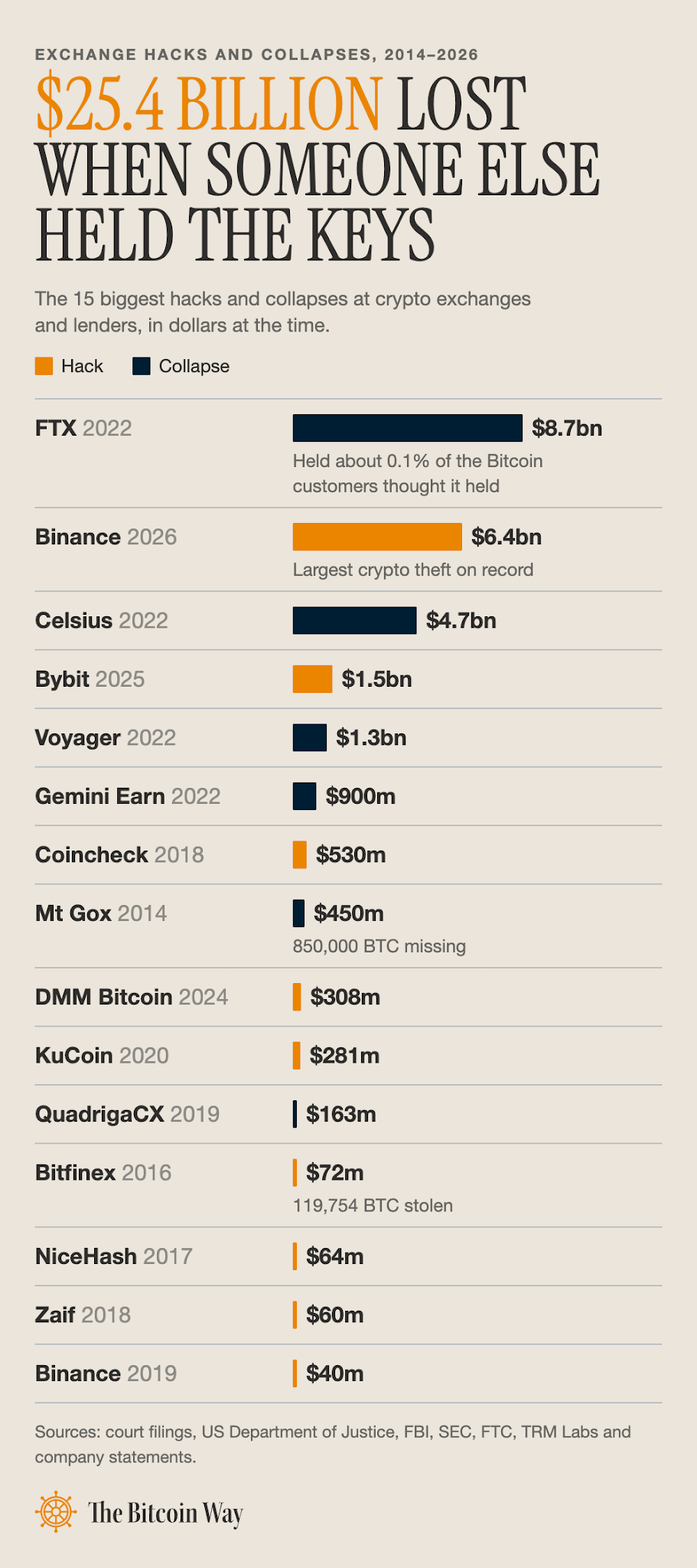
For the customers of platforms that famously collapsed, like FTX, Celsius, Voyager, Mt Gox, BlockFi, it wasn’t a matter of waiting a few days.
The bankruptcy proceedings lasted years, effectively holding user funds captive.
Some people were enticed by the generous yields paid on crypto assets, to the extent that almost their entire net worth was held by the bankrupt platform.
For these people, it was a life-destroying decision.
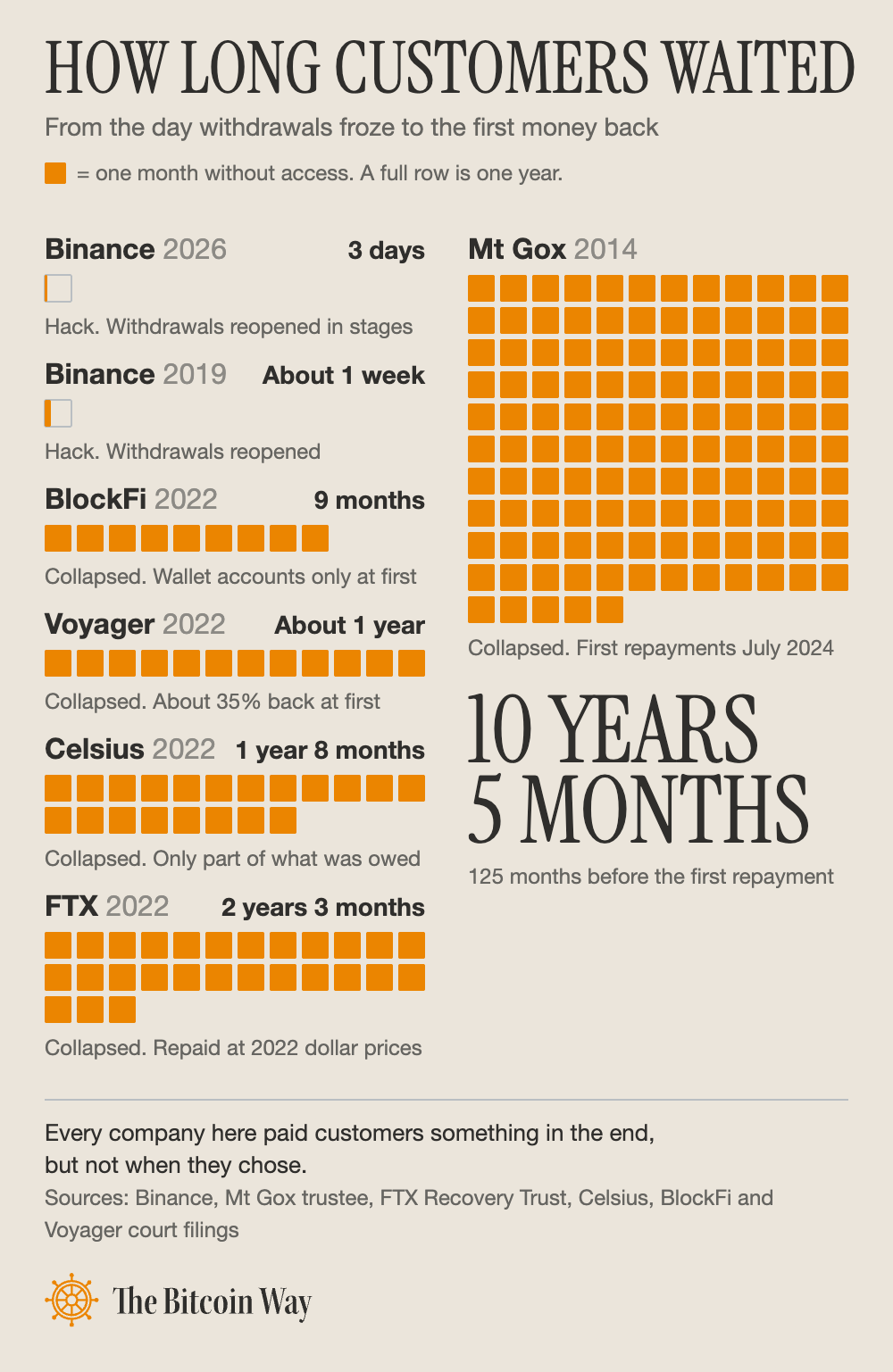
Many people have been unfortunate victims of custodial losses, whether through hacks or bankruptcy.
It’s probably safe to say that in hindsight, they wish they had held their Bitcoin in self-custody because it would have saved them weeks, months, and even years of anguish and uncertainty.
Fear is a major factor in why many people find themselves caught up in custodial collapses.
They know self-custody exists, but it seems like a scary step - full of unknowns.
Going down that road requires something we have never been trained to do with our money: take full responsibility for it ourselves.
And no, this isn't the same as holding your money in your own bank account or shares in your own brokerage account.
This means removing third parties from the equation ENTIRELY. Meaning there is not a single soul between you and your Bitcoin.
This process is full of what-ifs. What if I lose my seed phrase? What if my hardware wallet breaks? What if I forget my wallet passcode?
What if my house burns down and I lose everything?
Self-custody is not risk-free. There is risk in every choice.
But the difference is - when you use any type of custodian, you have to trust. You have no choice. Your Bitcoin is in their hands.
Ask yourself: if this company collapsed tomorrow, could I still access my Bitcoin? If the answer is ‘no’, then you need to make a change.
How to ensure that YOU own your Bitcoin
When you self-custody your Bitcoin, you can set up a system with no single point of failure. You can mitigate risk yourself.
This is what many people fail to understand - and is the reason why there is so much fear around self-custody.
And it doesn’t have to be complex. If you can log into a computer and send an email, you can self-custody your Bitcoin.
It just takes some knowledge and planning first.
Here are five steps you can take to ensure that your Bitcoin is in your control:
- First and foremost, do not leave your Bitcoin on an exchange. That means any exchange, no matter how trustworthy they seem. Treat any type of custodian with the same caution, and that includes Bitcoin lenders, collaborative custodians, ETFs - any business that holds your Bitcoin or any of your keys.
- Choose a Bitcoin-only air-gapped wallet. Air-gapped means it never connects to the internet or your computer. Bitcoin-only means less code, so fewer places for a flaw to hide. Buy it directly from the manufacturer or an authorised and trusted reseller, so it doesn’t pass through unknown hands.
- Create your own seed phrase instead of relying on a hardware wallet to do it for you. You can do this with the 100-dice-roll method or through camera entropy (specific to the SeedSigner).
- Run your own node - this is your own copy of Bitcoin’s transaction history, on a small computer at home. Without one, whoever runs your wallet’s server can see which addresses are yours. With one, you confirm payments yourself.
- Create an inheritance plan - if something happened to you tomorrow, would your family know your Bitcoin exists, where the backup is and how to use it? Plan it so they can, without weakening your security now. Never put your seed phrase in a will: wills can become public.
When you control your own Bitcoin with a secure self-custody setup, the biggest trade-off is usually convenience.
However, you no longer need to trust third parties. You can shed any fearful beliefs about self-custody, and you don’t need to worry about custodial hacks or collapses.