
Your Bitcoin Moved. Would You Know?

In this article:
Most Bitcoiners walk around with this smug little glow-up about their security game.
They’ve read the horror stories about exchanges getting rugged, yield farms turning into yield graves, fake apps, leaked databases, cloud backups that might as well be public billboards, SIM swaps, and the never-ending parade of people who thought convenience was harmless until it became expensive.
I can hear people saying “Yeah, but that’s not me. I’m not that dumb”. Naturally, we tend to assume the lesson is about someone else.
The person who left coins on an exchange. The retiree who clicked the fake link. The influencer who kept “a little bit” on a platform paying yield that was obviously too good to be real, except apparently not obvious enough at the time.
But eventually, serious Bitcoiners graduate from that world. They finally yank their coins off the exchanges (good), fire up a proper signing device (smart), run it through their own node (finally), and stop begging permission from companies that slap their name on stadiums right before the whole thing implodes like the fiat circus it is.
And then… they exhale. Big mistake. Because once you kick the custodian out of the picture, the danger doesn’t vanish. It just moves into your house, sits on your couch, and starts wearing your slippers. Now the weakest link isn’t some suit with a “we’re sorry” tweet. It’s you. Your process, your device, and that backup you haven’t tested since 2022. That old habit you swear is fine. That little blind spot nobody wants to talk about because it’s not as sexy as “number go up”.
Here’s the real gut-punch question nobody asks out loud: Would you actually know if your Bitcoin just moved?

Bitcoin won’t warn you out of courtesy. It doesn’t run a background check on the address. It doesn’t freeze the transfer because “that doesn’t look like something you would do”. That’s fiat-world training wheels. And Bitcoin’s entire point is to say “screw your training wheels”.
It settles valid transactions. Period. Signed it by accident? Signed something you didn’t fully read? Exposed a seed phrase for three seconds in 2024? Got phished by some shitcoin-adjacent scammer pretending to be support? Doesn’t matter. The protocol doesn’t care how you feel about it. It just… settles. That’s the uncomfortable truth of real self-custody.

Holding your own keys removes the middleman. It doesn’t remove the need to keep your eyes wide open.
The Theft Had Already Happened
Rick Messitt, years before becoming our Chief Strategy Officer at The Bitcoin Way, wasn’t new to Bitcoin.
He got onboard in 2014, back when Bitcoin still felt like an obscure internet experiment to most of the world. He and his father understood the value early, then spent years doing what serious Bitcoiners are supposed to do: they accumulated, ignored the noise, avoided the casino, and kept their coins away from custodians.

That decision saved them from the endless graveyard of bankruptcies, rug pulls, and “your assets are safe with us” lies that swallowed the rest of the crowd. No bankruptcy court telling them their coins were “missing but don’t worry, our lawyers will circle back”. No refreshing a dead platform’s status page praying the adults in the room might eventually find the money. Their Bitcoin was in self-custody.
After years of stacking, Rick and his father had built a 25 Bitcoin position. But there was a critical weakness in the setup: private key material had been stored in a self-hosted password manager connected to a home server and backed up to the cloud. Once that server was compromised, the attacker found what they needed, and the coins were taken. What followed was the usual on-chain escape routine: funds moved, trails blurred, and laundering methods like mixers and privacy coins, until recovery went from “maybe” to “good luck, bro”.

But the part that matters most for this story is not only that the Bitcoin was stolen. It is when they found out.
Rick and his dad were in El Salvador for the Adopting Bitcoin conference. They casually checked the wallet that was supposed to be holding a decade of their life’s work. Balance: zero. The theft, however, was already old. For two months, they had been living with the belief that the coins were still there. Life carried on. There was no urgent call, no warning shot, no flashing red light telling them that a decade of savings had already left the building.
That is the part that sticks with you like a bad hangover. For months, the wallet had been telling a story nobody was reading. The transaction had already happened. The trail was already going cold. The attacker had already been handed the one advantage you can never get back: time.

By the time Rick and his father finally opened the wallet in El Salvador and saw nothing but a big fat zero, the emergency was long over. They weren’t watching a theft happen in real time. They were standing in the smoking rubble of one that had already finished the job. Every single hour that passes gives the attacker more runway. Bitcoin had done exactly what Bitcoin does. It settled a valid transaction. The missing layer was awareness.
Rick has told his own story publicly, including in his “How Secure Is Your Bitcoin?” talk at BTC Prague 2024 and on The Bitcoin Way Podcast, reflecting on what he learned after the hack and how Bitcoin security had changed since he first got into it around ten years earlier.
Security Fails on Ordinary Days
Whenever a Bitcoin loss story becomes public, the comment section fills with people who suddenly become world-class security experts.
They know exactly what they would have done. They would have spotted the fake app, checked the URL, verified the download, tested the backup, used the right device, noticed the warning sign, avoided the trap, and calmly executed the perfect procedure under pressure. And maybe they would have.
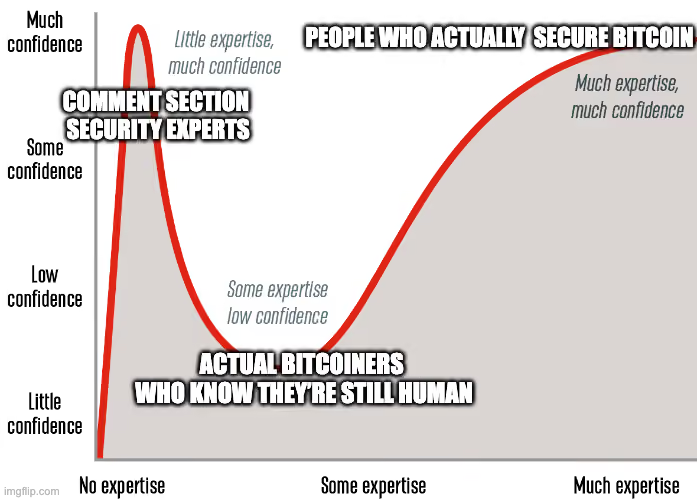
But serious security isn’t built around imaginary perfect behavior. It is built around real people on real days: tired after travel, rushing between calls, replacing a laptop, helping family, distracted by work, overconfident because the setup has worked for years, or simply trusting a process that should have been reviewed long ago.
That is where stories like Rick’s matter.
His lesson wasn’t that self-custody is too dangerous. Self-custody is exactly what kept him away from the custodial graveyard for years. The real takeaway is that self-custody can never be treated like a finished project you set up once and then stop thinking about. Your stack keeps growing, your risk profile shifts along with it, the tools evolve, the attackers sharpen their tactics, and the amount at stake quietly balloons in the background while yesterday’s setup simply ages in place, becoming more vulnerable with every passing month.

A recent story involving musician Garrett Dutton, better known as G. Love, drives home the same uncomfortable truth from a slightly different angle.
He wasn’t playing with some obscure token or chasing yield on a platform promising “safe” returns with the confidence only insolvency can produce. He was setting up a new computer. He downloaded what appeared to be a Ledger app from the Apple Store, entered the words he should never have entered, and nearly 6 Bitcoin disappeared.

One ordinary moment can become permanent. One convincing interface can turn into a life-changing mistake. One missing layer can decide whether you catch a problem quickly or discover the damage after the trail has already started to disappear.
The First Minutes Matter
Once Bitcoin moves, the clock starts working against you.
That doesn’t mean every theft can be reversed. It can’t, but the response window isn’t always zero. In 2025, on-chain investigator and security researcher ZachXBT tracked a 3,520 BTC theft from an elderly U.S. holder. The funds moved quickly, and most were pushed into privacy coins, where tracing becomes dramatically harder. But around $7 million was later frozen after coordination with Binance and investigators. That isn’t a happy ending but a very expensive lesson.

If movement is detected early, there may still be something to do. In rare cases, if the transaction is still unconfirmed and the right conditions apply, a replacement transaction may be possible. More often, early detection means moving remaining funds, identifying the transaction while the trail is still fresh, and getting the relevant transaction IDs and UTXOs in front of investigators or exchanges before the attacker has finished the next step. It isn’t exactly a happy ending, but a lesson in why speed matters more than almost anything else once Bitcoin has already moved.
Every delay gives the other side more room. Coins can be split, swapped, routed, mixed, or sent through venues where cooperation becomes slower, harder, or impossible. What starts as a live incident can quickly turn into a historical reconstruction.
Early awareness doesn’t guarantee recovery. Late awareness guarantees fewer or no options.
Why Watch-Only Wallets Are Not the Answer
Once people understand the need for faster awareness, they usually reach for the obvious answer: put a watch-only wallet on the phone.
On the surface, that sounds reasonable. You get to peek at balances and transactions without ever storing the private keys on the device, so the phone can’t spend anything. Visibility without the spending power. Clean compromise, right? The problem is that Bitcoin security isn’t only about whether someone can spend your coins. It’s also about what they can learn.

Your phone is the single most compromised piece of hardware you own. It bounces through airports, hotels, taxis, repair shops, border checks, public Wi-Fi, cloud backups, random app permissions, and all those casual moments where someone else has it in their hands longer than you realize. Now imagine handing that same phone a live map of your entire Bitcoin stack including addresses, balances, transaction history, the whole damn shape of your wealth.
That information has value even without the private keys. It can confirm that you are worth targeting, give an attacker a better picture of your setup, or turn a stolen phone into something far more useful than a stolen phone should ever be. So yeah, “just monitor it from your phone” sounds responsible… until you actually think about it for five seconds.

The aim is awareness without exposure. You want to know immediately if something moves, while keeping the phone as boring as possible to anyone else who touches it. No visible balance. No address list. No transaction history sitting there for a thief, attacker, border agent, repair technician, or compromised app to discover.
A proper monitoring layer should alert you when something happens without turning your phone into a Bitcoin dashboard.
Silent Until It Matters
This is the problem we wanted to solve.
A serious Bitcoin setup needs awareness, but awareness shouldn’t come at the cost of privacy. Putting a watch-only wallet on your phone may solve the visibility problem, but it creates a new exposure problem. Sending wallet data to a third-party service would be even worse, because the whole point of building your own setup is to reduce the number of people and companies who can see anything in the first place.
So we built a realtime bitcoin monitoring service for existing clients. It runs on your own Start9 server, watches your wallet addresses automatically, and sends private alerts to your phone and computer if any transaction occurs. Incoming or outgoing.

If you want the more technical breakdown of the service, we explain it here: Realtime Bitcoin Monitoring: Why Your Secure Setup Still Has a Blind Spot.
There is no watch-only wallet on your phone, no balance displayed, no address list sitting in an app, and no third party watching your coins. Not even us. Everything runs on your infrastructure. If nothing happens, the system stays quiet. You don’t have to check your node every morning. You don’t have to expose your stack just to know whether something moved. You finally get to stop choosing between “blind” and “walking billboard”.
When a transaction occurs, you get the alert. An alert doesn’t magically undo a mistake but it gives you a chance to respond while response may still matter.
First, you check whether you initiated the transaction. If you didn’t, you contact us immediately through your private Signal group. From there, we help assess the situation and guide the next steps. Depending on the circumstances, that may include attempting a replace-by-fee response, moving remaining funds, or getting transaction IDs and UTXOs in front of professional investigators quickly.
There are no guarantees in Bitcoin recovery. Anyone promising certainty is selling fantasy. But speed gives you options. And in Bitcoin recovery, options disappear fast.
Self-Custody Has to Keep Evolving
People make mistakes.
That part matters, because Bitcoin doesn’t grade on reputation. It doesn’t care how long you have been around, how many cycles you have survived, how many conferences you attend, or how deep your conviction runs. One weak point, one bad assumption, one setup decision left unchallenged for too long can be enough.
That is why self-custody has to keep evolving. Taking possession of your keys is the beginning, not the finish line. From there, the work becomes more practical: better signing practices, better infrastructure, better backups, better inheritance planning, better personal cybersecurity, and better awareness when something changes. Realtime Bitcoin Monitoring is one more layer in that evolution.

But the point is this: whether you need monitoring, a proper self-custody setup, help reviewing your current process, or guidance on how to remove the obvious weak points before they become expensive, you don’t need to figure it all out alone. If you need help with any part of your Bitcoin custody, or you are ready to take proper custody for the first time, book a free, 30-minute introductory call with one of our advisors.
We’ll help you understand where you are today, identify the gaps, and build a setup designed for privacy, control, and resilience.
Close the gap before the gap becomes the story.