
Your Government Has a Churn Problem
In this article:
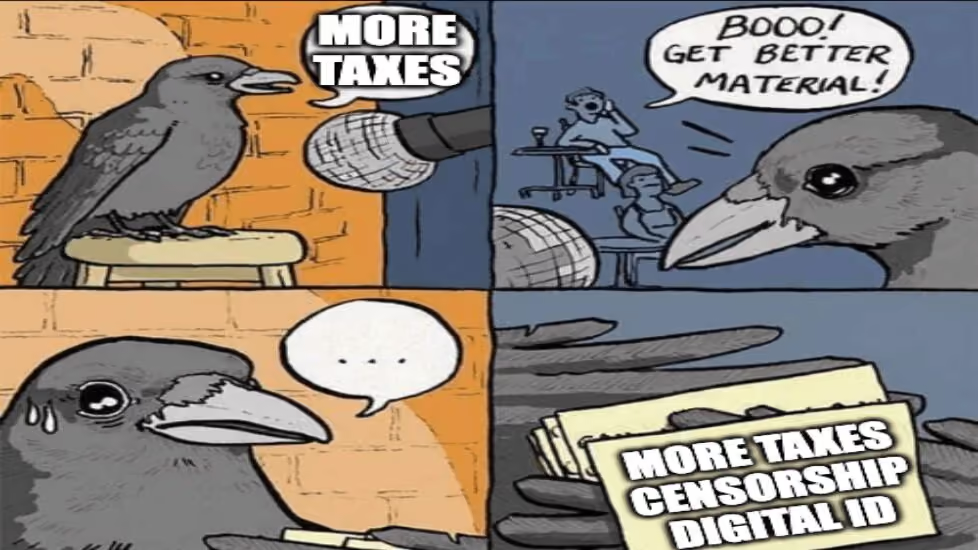
Australia kicked off the clown show in December 2025 with its ban on social-media accounts for anyone under 16. Six months later, Britain decided that was a brilliant idea and jumped on board. Meanwhile, the European bureaucrats were busy cooking up wealth and exit taxes because nothing says “we respect your freedom” like slapping extra charges on people who dare to take their capital and walk.
At roughly the same time, El Salvador was promoting reforms intended to attract people whose income, businesses and Bitcoin could move across borders. One set of governments is obsessed with better ID checks, tighter access controls, and making damn sure they keep a claim on your wealth even if you try to leave. The other is asking a much simpler question: what do we actually have to offer so you’ll show up in the first place?

That contrast is the part the modern state would rather not discuss out loud. For most of history, governments had the ultimate locked-in customer base. You were born into the subscription, chained down by job, house, family, bank accounts, and language. The service could turn to absolute rubbish, the fees could keep climbing, and the terms could get rewritten whenever the politicians felt like it. Leaving still meant torching pretty much everything you had built.
Enviable business model, of course only if you’re the one collecting the cut. Citizens could vote, complain or occasionally replace one administrator with another promising to operate the same machinery more compassionately. Departure remained sufficiently expensive that loyalty rarely needed to be earned. So the state just assumed your continued presence was enthusiastic consent. Like a prison taking the lack of successful breakouts as glowing five-star reviews. That comfortable little delusion is starting to crack.

Remote work has separated income from location, digital businesses can operate across several countries, and Bitcoin allows meaningful wealth to move without requiring a domestic bank to approve the destination. Relocation remains difficult, particularly when family, property and legal obligations are involved, but a growing number of productive people now possess something governments have never particularly enjoyed them having: a viable alternative.
They can compare jurisdictions according to what they offer, what they demand and how aggressively they interfere with private life. Taxes matter, although so do residency requirements, legal stability, banking access, digital freedom and the amount of time one must spend proving to various departments that one remains entitled to use the internet.
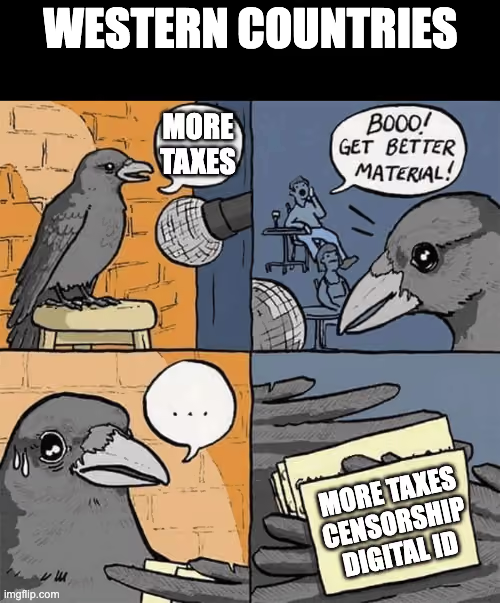
The relationship between the individual and the state is therefore beginning to look less permanent and more conditional. Some governments have recognized the change and begun competing for mobile people. Others appear determined to remind the customer that cancellation may incur additional charges.
Governments Have Started Shopping for Citizens
Countries have always fought tooth and nail over factories, big corporations, and foreign capital. What is changing is that they are increasingly competing for individuals whose businesses, income and capital can move with them.
Remote professionals, digital entrepreneurs, and especially Bitcoin holders aren’t chained to one jurisdiction anymore. They can relocate without moving a factory, rebuilding an entire company or asking a domestic bank to approve the journey, which gives them something most taxpayers have historically lacked: leverage. And leverage changes everything.
That changes how jurisdictions actually compete. Low taxes don’t usually come alone, they tend to arrive bundled with the rest of the package: residency that doesn’t require a small army of lawyers, banking that actually works, decent international connectivity, legal predictability, and enough personal freedom that moving feels like an upgrade instead of swapping one extraction machine for another.

Mobile people therefore judge the entire arrangement, including how much time the country demands, how easily a family can settle, whether businesses can operate smoothly and how likely the government is to rewrite the rules once everyone has unpacked.
Some governments have understood this and begun designing policies around the people they hope to attract. They are reducing friction, offering clearer terms and accepting that loyalty becomes harder to demand once the customer discovers a comparison website. They have recognized the same uncomfortable fact: citizens with credible alternatives must be persuaded.
Panama, El Salvador and the Business of Attraction
Panama has understood the value of the mobile citizen for longer than most.
Its appeal begins with a territorial tax system, under which residents are generally taxed on income earned inside Panama rather than income generated elsewhere. For entrepreneurs, remote professionals and internationally mobile families, that creates a far more attractive proposition than the Western habit of treating success abroad as unfinished business for the tax authority at home.

The country also offers the practical foundations needed to turn a residency card into a workable life. Panama City provides international connections, healthcare, restaurants, professional services and a business culture accustomed to people whose affairs span several countries. Beyond the capital, mountain towns, tropical forests and long stretches of coastline offer a quieter pace for those whose idea of sovereignty includes occasionally hearing something other than traffic and government announcements. A Plan B becomes much more convincing when it offers favorable rules alongside somewhere you might genuinely prefer to wake up.
Panama also allows people to secure legal residency without immediately relocating every part of their lives. Depending on the route used, residency can be maintained with relatively limited physical presence, giving individuals time to decide whether the country should remain an emergency option or eventually become their primary base.

A second residency doesn’t require you to wake up one morning, sell the house and inform your family that everyone is moving to Central America because a government consultation document looked ominous. It simply creates another lawful place to go, removing some of the pressure from whatever decision comes next.
We saw that firsthand when more than fifty Bitcoiners travelled with us to secure Panamanian residency. They arrived for the paperwork, but the experience also showed them what a functioning Plan B can look like when it includes community, infrastructure and a country in which they could genuinely imagine spending more of their lives. We covered the full trip in An Adventure in Panama.

Panama’s offer is particularly relevant to Bitcoin holders because self-custody solves only part of the sovereignty problem. Your money may no longer depend on a bank, while your residence, company, family and estate remain governed by legal systems whose rules can change with considerably less warning than the average software update.
El Salvador has clearly spotted the same shift. Its government has leaned hard into a Bitcoin-first international identity and paired it with favorable treatment of foreign-source income and Bitcoin gains.
Recent reforms cut the annual physical-presence requirement for temporary residents down to just 90 days. That makes residency realistic for people who cannot or flat-out refuse to spend most of the year pinned to one location.The message is refreshingly blunt. Bring your capital, your skills, and your economic activity here, and we will take less of your income and less of your time.

None of this makes the government permanently benevolent. Tax codes can always be rewritten when the political incentives shift. Still, it shows that at least some states have read the room and decided to compete for people who actually have options.
They are trying to earn the arrival. Elsewhere, governments seem far more interested in making departure painful. Age verification here. Exit taxes there. More surveillance everywhere. It is the same old reflex. If you cannot keep them happy, at least make leaving expensive.
When Retention Becomes Restraint
Elsewhere, governments have responded to greater mobility by tightening the conditions of participation.
Australia began enforcing its social-media restrictions for under-16s in December 2025, and Britain has announced that it will follow with its own ban in spring 2027. There are legitimate reasons to worry about children being psychologically tenderized by algorithms designed to keep them scrolling. That legitimacy is precisely what makes the argument so politically useful. Intrusive laws are rarely introduced as intrusive laws. They arrive wrapped in a moral objective the public can hardly oppose: protect children, stop terrorism, prevent abuse. The emotional premise comes first, narrowing the space for disagreement before anyone examines the machinery being proposed.
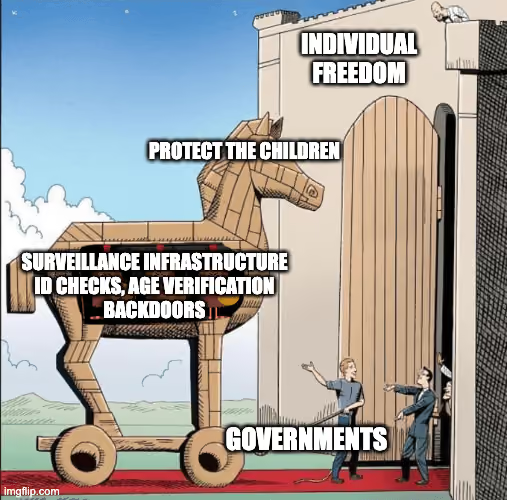
This is called affective framing. The public is emotionally primed, criticism is redirected towards the most distressing possible outcome, and support for the underlying value is treated as consent for the legislation attached to it. Anyone questioning identity checks, message scanning or device surveillance can then be portrayed as questioning children’s wellbeing rather than the means chosen to protect it.
The more revealing question is therefore not whether children deserve protection, but what must be built in their name, who else it will examine and how long its use will remain confined to the original purpose.

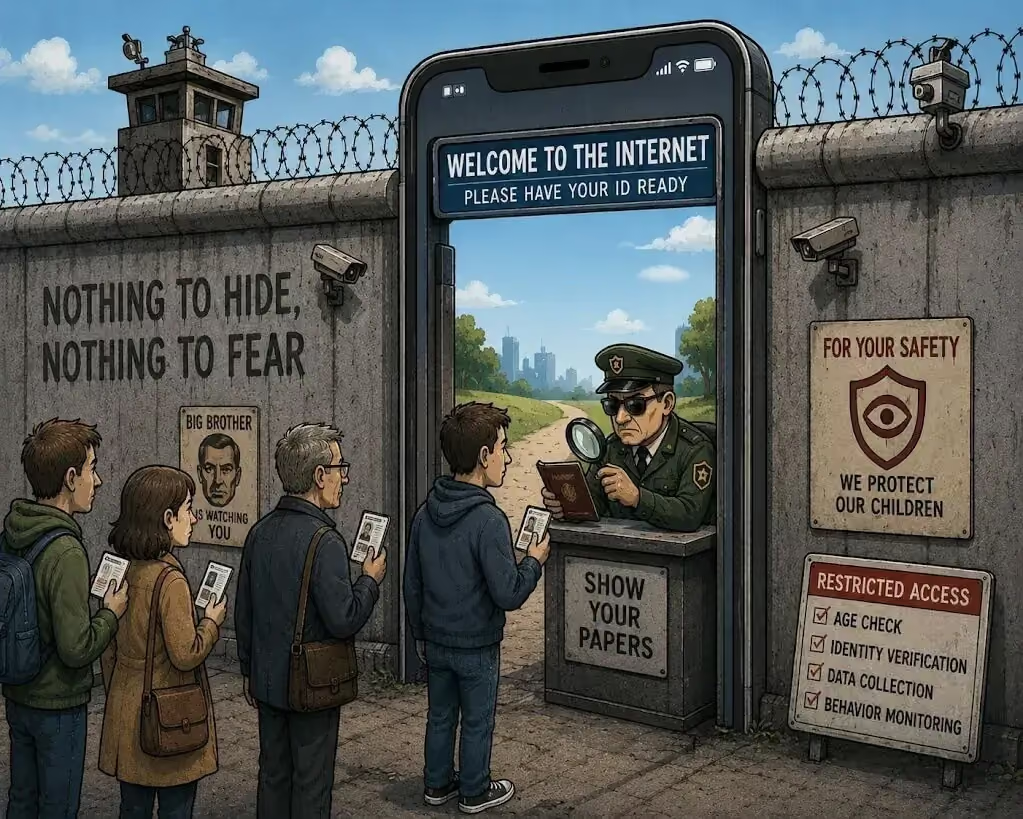
A platform cannot reliably exclude a fifteen-year-old without distinguishing them from everyone else through identity checks, facial or voice analysis, account activity, device information and location signals. Australia even expects platforms to address attempts to circumvent the restriction through VPNs. The policy may claim to target children, but the tools required cannot magically stop at adults. Every user ends up having to prove they belong on the permitted side of the line.
That machinery is already becoming visible in Britain. That machinery is already becoming visible in Britain. After updating their iPhones, UK users are now being prompted to confirm that they are adults, with Apple offering methods including an existing credit card or a scan of a passport, driving licence or other government-issued identification. What was once a personal device now greets its owner with an identity checkpoint before deciding which parts of the digital world they are old enough to enter.
Private messaging has not escaped the same pressure. Britain’s Online Safety Act gives Ofcom the power, subject to statutory conditions, to issue technology notices requiring regulated services to identify certain terrorism or child-sexual-abuse material. Signal and WhatsApp have warned that applying proactive scanning to end-to-end encrypted conversations would undermine the privacy the encryption is supposed to provide.
Britain isn’t currently reading every message sent through either service, but the legal architecture creates a familiar dilemma. A provider may eventually be asked to weaken the product, introduce scanning before encryption takes place or reconsider whether it can continue operating under rules that conflict with its basic design. Encryption cannot keep everyone out while installing a government-approved entrance around the back.

Brussels has pursued a similar ambition through the proposal commonly known as Chat Control. Its most aggressive elements remain contested, and the Council’s current position favours making voluntary scanning permanently lawful rather than imposing universal detection. Even so, the direction is revealing. Private correspondence is increasingly treated not as a protected space, but as another technical system that should remain available for inspection whenever the right administrative justification can be supplied.
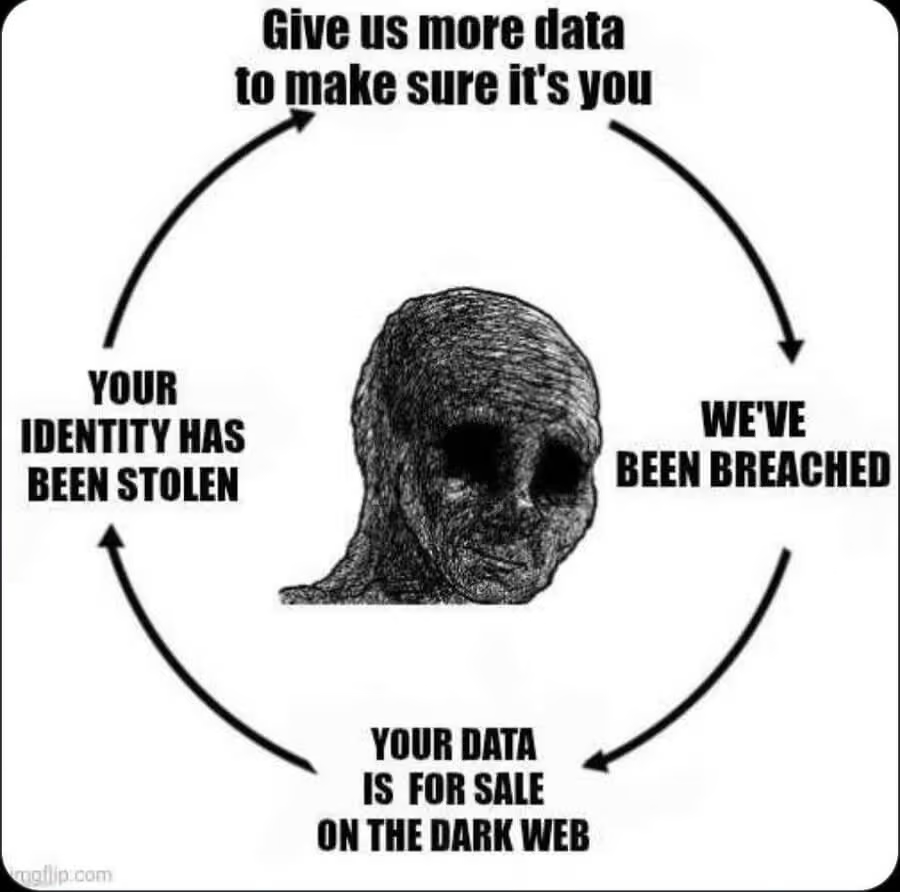
The same instinct appears in financial policy. Britain already has temporary non-residence rules that can bring certain gains made abroad back into the tax net when someone returns within the relevant period. Meanwhile, a European Commission study published in April examined wealth, capital and exit taxes alongside information-sharing and asset-registration systems, just as governments are confronting the irritating discovery that successful people and their assets are becoming less geographically obedient.
We examined the wider implications of that study in The Signal Most People Will Ignore, including the growing interest in wealth registers, unrealized gains and preserving the state’s claim on capital after its owner has left.

The pattern matters before every consultation becomes legislation and every exceptional measure becomes routine infrastructure. Some countries are reducing the cost of arrival. Much of the West is expanding the systems needed to verify identity, inspect communications, follow assets and preserve claims after departure.
A company facing customer churn might improve the product. While a government can ask for more identification and make cancellation rather unpleasant.
Make Yourself Harder to Control
Your government wants to know who you are, where you are, what you own, what you say, how you communicate and whether any part of your wealth has escaped its reach.
It wants platforms to verify your identity, devices to confirm your age, messaging apps to make private conversations readable and banks to report even more of your activity. At the same time it is busy figuring out how to tax more of what you earn, keep a permanent claim on what you own and make sure leaving the country doesn’t mean leaving the tax net behind.

Put bluntly, your government is trying to tax you to death while building the infrastructure to track every meaningful movement you make. If that makes you uncomfortable, good. It should. The real mistake is thinking there is nothing you can do about it.
Bitcoin gives you the ability to hold wealth outside the banking system, but that freedom remains fragile if your keys sit on an exchange, your communications leak through insecure technology, your family cannot recover your funds or your legal existence depends entirely on one jurisdiction. The good news is that every one of those vulnerabilities can be reduced.

You can secure your Bitcoin against theft, coercion and loss of private keys. You can harden the technology through which you communicate and manage your wealth. You can create an inheritance plan that doesn’t leave your family with a cryptographic dilemma. You can establish residency in another country before relocation becomes urgent, giving yourself a lawful exit instead of a desperate escape.
That is what a real Plan B provides. It doesn’t require you to abandon your current life or spend every morning searching for the next government consultation. It gives you enough financial, digital and geographic resilience that one policy change, frozen account or compromised device cannot determine your future.

Governments are preparing for a world in which citizens are easier to identify, monitor and tax. You should be preparing for a world in which you are much harder to trap. At The Bitcoin Way, we help people protect their Bitcoin, secure their digital lives, build a practical Plan B beyond their current jurisdiction, and become more sovereign. Book a free, 30-minute introductory call with one of our advisors and find out where your freedom still depends on somebody else’s permission.