
Realtime Bitcoin Monitoring: Why Your Secure Setup Still Has a Blind Spot
In this article:
Realtime Bitcoin Monitoring: Why Your Secure Setup Still Has a Blind Spot
You did everything right.
Air-gapped hardware wallet. Your own Bitcoin node. Electrum server running on your Start9. No single points of failure. No third parties holding your keys. No exchange custody. You are in the top fraction of a percent of Bitcoin holders when it comes to security.
So why should you be worried?
Because your setup is quiet. And quiet means slow.
The problem no one talks about
Most conversations about Bitcoin security focus on preventing theft. And they should. But almost no one talks about what happens after prevention fails.
Not if. After.
Phishing attacks are getting more sophisticated. Social engineering targets real people, not just systems. Physical access happens. Backup information can be exposed. Seed phrases can be compromised through human error, not technical failure.
The probability is low. But it is not zero.
And here is the part that matters: if an unauthorized transaction happens on your wallet, how fast do you find out?
If you are running a proper setup -- air-gapped wallet, your own node, no watch-only wallet on your phone -- the honest answer is: you might not find out for days. Maybe weeks. Because you are not sitting at your computer checking your wallet application every morning. You should not be. That is the whole point of a secure, low-touch setup.
But that delay is the gap. And in Bitcoin, time is everything.
Why time matters during an attack
When an unauthorized transaction hits the blockchain, a clock starts. What happens in the first few minutes determines whether you have options or whether you are just watching your Bitcoin leave.
In the first minutes: If you are alerted immediately, you may be able to broadcast a replace-by-fee (RBF) transaction. This sends a competing transaction with a higher fee that redirects the funds to an address you control. If the original transaction has not been confirmed yet, yours can replace it. The attacker gets nothing.
In the first hours: If the transaction has already confirmed, you can still identify the transaction IDs and UTXOs involved. You can move any remaining funds to a new wallet before the attacker comes back for a second sweep. And you can get the transaction data in front of professional blockchain investigators while the trail is still fresh.
In the first days: Investigators can track the movement of stolen funds across the blockchain. If the attacker tries to cash out through an exchange, the exchange can be notified and the funds can potentially be frozen. The earlier the detection, the shorter the chain of transactions, and the easier it is to track.
After weeks: The trail is cold. Funds have been moved through multiple hops, mixers, or cross-chain swaps. Recovery becomes extremely unlikely.
The difference between "minutes" and "weeks" is the difference between recovery and loss. And the only thing that controls which scenario you end up in is awareness. Specifically, how fast you know something happened.
The watch-only wallet trap
This is where most people get stuck. They know they want visibility. So they ask: "Can I just put a watch-only wallet on my phone?"
On the surface, it makes sense. A watch-only wallet shows your balance and transactions without storing your private keys. You can see what is happening without being able to spend.
But there is a serious problem with this approach.
If your phone is lost, stolen, or compromised, whoever has it now knows exactly how much Bitcoin you hold. They can see every address, every transaction, every balance. They do not need your keys to know you are worth targeting.
That information alone makes you a target for physical attacks, social engineering, and extortion. It is the exact kind of exposure that your air-gapped setup was designed to prevent.
Putting a watch-only wallet on your phone undoes a significant part of your security model for the sake of convenience. It is a tradeoff that is not worth making.
A better approach: monitor without exposing
The right solution monitors your wallet without putting any information on your phone. Nothing visible. No app showing your balance. No transaction history. No address list. Your phone looks exactly like everyone else's phone.
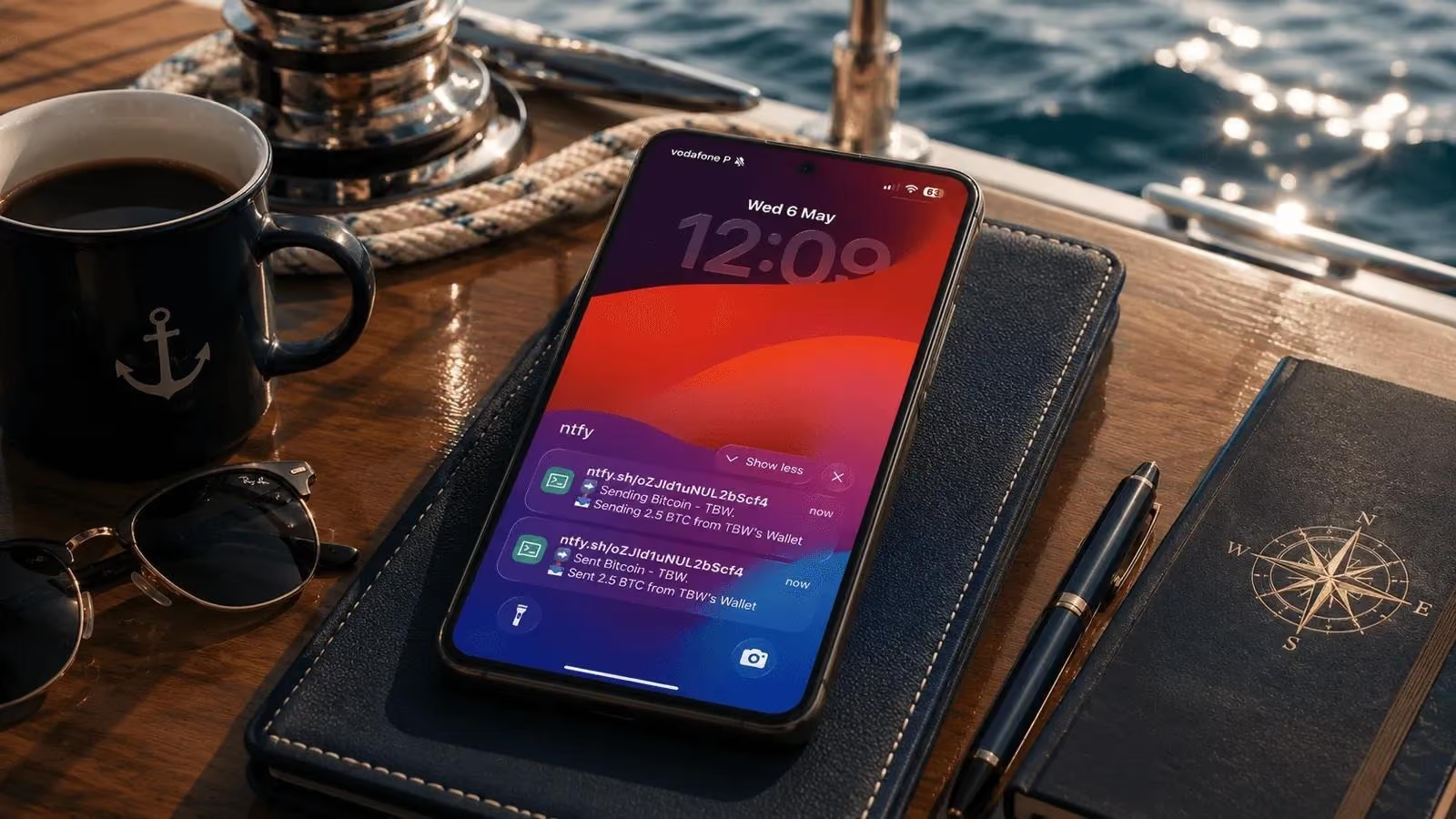
The only thing that changes is this: if a transaction occurs on any of your wallet addresses, you get an instant notification. That is it. A silent alert that tells you something moved.
If it was you, you ignore it. If it was not you, you act immediately.
This is the difference between a watch-only wallet and a monitoring system. The watch-only wallet shows everything all the time. The monitoring system shows nothing until it matters.
How self-hosted monitoring works
The monitoring layer runs entirely on your own infrastructure. Specifically, on the same Start9 server that already runs your Bitcoin node and Electrum server.
Here is what happens:
- Your extended public keys (XPubs) are imported into a monitoring application on your Start9. This allows the application to derive and watch every address your wallet has ever generated or will generate.
- The monitoring application connects to your Bitcoin node and Electrum server. It watches the blockchain in real time for any transaction involving your addresses.
- When a transaction is detected -- incoming or outgoing -- the application triggers an alert through a private, open source notification system installed on your phone and computer.
- The notification system does not use email, SMS, or any phone number. There is no identity linkage.
- Everything stays on your hardware. No third party -- including the service provider who configured it -- can see your addresses, your balances, or your alerts.
This is the critical difference between self-hosted monitoring and third-party monitoring services. With a third-party service, you are handing your XPubs to someone else's server. They can see every address you have ever used, every balance, every transaction. You are trusting them not to leak, sell, or lose that data.
With self-hosted monitoring, the data never leaves your infrastructure. The only person who sees the alerts is you.
What to do when an alert fires
Having the alert is only half the equation. Knowing what to do with it is the other half.
When you receive a notification, the first step is simple: did you initiate this transaction? If yes, you are done. Ignore it and move on.
If no, the following steps should happen immediately:
Step 1: Verify the transaction. Open Sparrow on your laptop and check the transaction details. Confirm that it is real and not a false positive.
Step 2: Attempt to replace the transaction. If the transaction is unconfirmed, you may be able to broadcast an RBF transaction that redirects the funds. This requires speed -- if the original transaction confirms first, this option closes.
Step 3: Secure remaining funds. If you have other UTXOs in the same wallet, move them immediately to a new wallet that has not been compromised. Do not wait.
Step 4: Contact your security team. If you work with a Bitcoin security provider, get them on a call immediately. They can help assess the scope of the breach, guide your response, and coordinate with investigators.
Step 5: Engage blockchain investigators. Professional firms specialize in tracing stolen Bitcoin across the blockchain. The earlier they receive the transaction data, the better the chances of tracking and potentially freezing the funds before they reach an exchange.
Having a documented emergency response plan -- written before anything happens -- means you are not making decisions under panic. You already know the steps. You just execute.
Who this is for
Self-hosted Bitcoin monitoring is not for everyone. It is specifically for people who:
- Already run their own Bitcoin node on a Start9 or similar server
- Use an air-gapped hardware wallet (Coldcard, Foundation Passport, SeedSigner)
- Connect their wallet to their own Electrum server (Electrs or Fulcrum)
- Have made the deliberate choice to avoid watch-only wallets on their phone
- Want awareness without sacrificing the privacy and security they have already built
If you do not have this infrastructure in place, monitoring is not the first step. Building the secure foundation is. Once that foundation exists, monitoring is the natural next layer.
The security camera analogy
Think of your Bitcoin setup like a house.
Your air-gapped wallet is the secure door and your Bitcoin node is the alarm system. You have done everything to prevent a break-in. You have built a ultra secure vault.
But if there is no camera, and no one is watching the feed, a break-in could happen and you would not find out until you walk through the front door days later.
Self-hosted Bitcoin monitoring is the camera. It does not prevent the break-in. It makes sure you know the moment it happens so you can respond while there is still time.
And unlike a traditional security camera, this one does not record your daily life. It does not show your balance. It does not track your activity. It sits silently and only activates when something unexpected occurs.
The bottom line
Bitcoin security is not just about prevention. It is about awareness. The best locks in the world do not help if you do not know they have been picked.
If you have already invested the time and effort into building a proper self-custody setup, monitoring is the piece that ties it all together. It turns a secure but passive system into a secure and actively monitored one.
Not because something is likely to go wrong. But because if it ever does, the difference between knowing in seconds and knowing in weeks is the difference between keeping your Bitcoin and losing it.